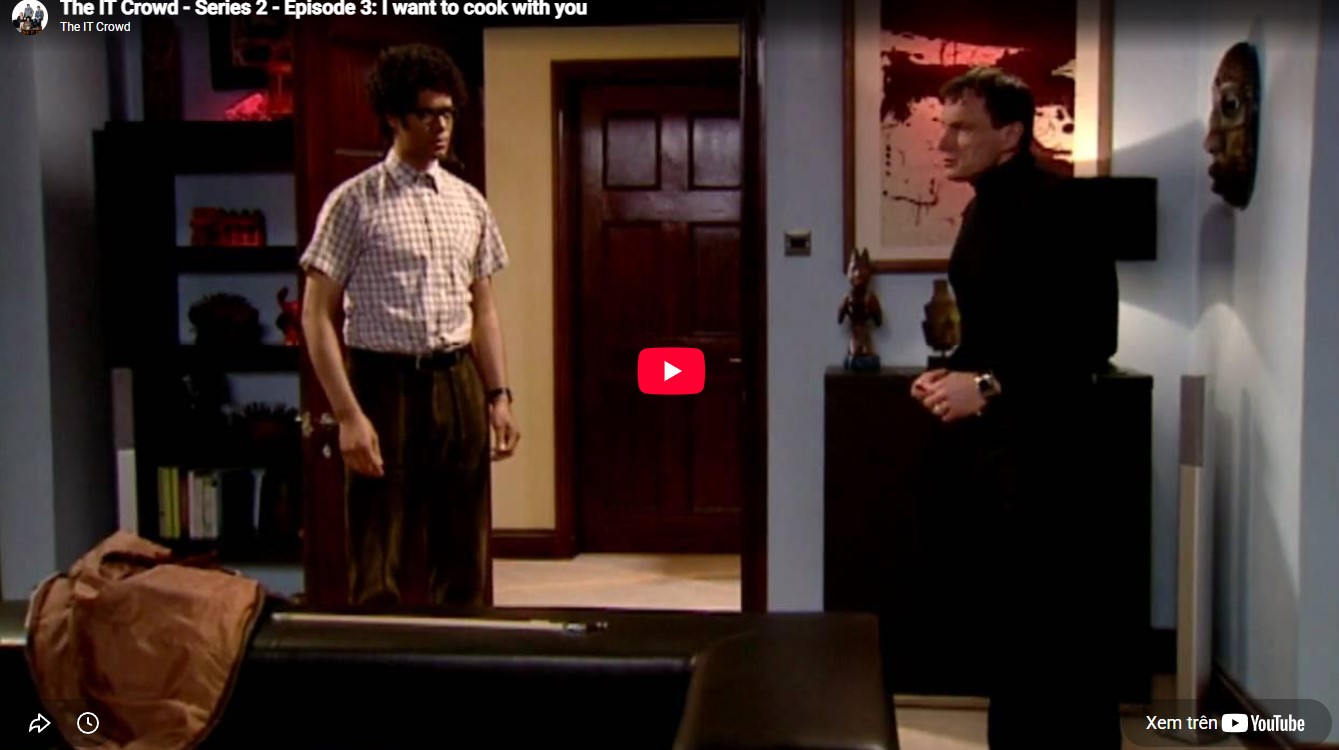
At 11:47 on a rainy Thursday night, the computers on the seventh floor of Reynholm Industries all turned on at exactly the same time, and somewhere in the darkness beneath the city, a printer began printing a photograph of a man who had been dead for nine years.
Nobody was supposed to be in the building.
That was the first problem.
The second was that the photograph was being printed from the IT department.
And the third was that Moss, who had spent most of his life believing computers were considerably more trustworthy than people, looked at the image and immediately whispered something that made Roy stop laughing.
“That’s impossible.”
Roy turned slowly in his chair.
“What is?”
Moss didn’t answer.
The fluorescent lights above them flickered with the tired rhythm of an old horror movie projector. Outside the basement windows, London was disappearing beneath rain, its streets transformed into black mirrors reflecting red buses, yellow windows and the occasional blue flash of a passing police car. The building itself had long since emptied. The sales department had gone home. Human Resources had gone home. Even the mysterious man from Legal who never seemed to blink had gone home.
Only the IT department remained.
As usual.
Roy was halfway through watching a video on his monitor when the printer behind him made a mechanical clicking sound.
He didn’t look.
“It’s probably nothing.”
Moss stared at the photograph.
“It has printed three copies.”
Roy sighed.
“Then it’s probably three nothing.”
Moss picked up the paper.
The photograph showed Denholm Reynholm standing in the old Reynholm Industries lobby, wearing the same dark suit he had worn in hundreds of corporate photographs. He was younger than Moss remembered, smiling with the enormous confidence of a man who believed every problem in the world could be solved by making the problem sign a contract.
But there was something wrong.
Behind him, half-hidden by a glass door, stood another figure.
A woman.
She was looking directly into the camera.
And beneath the photograph, printed in tiny black letters, were six words.
PLEASE DON’T LET JEN SEE THIS.
Moss swallowed.
That was when the elevator began moving.
Down.
The IT department was in the basement.
There was nowhere below them.
Yet the elevator indicator showed the number -1.
Roy finally looked away from his screen.
“Did you see that?”
Moss nodded.
The elevator stopped.
The doors opened.
There was nobody inside.
For several seconds, neither man moved.
Then Roy pointed toward the elevator.
“You go.”
“Why me?”
“You’re more emotionally equipped.”
“I don’t believe that.”
“Neither do I.”
Before Moss could answer, the telephone rang.
It was the old red telephone on the corner of the desk, the one nobody used anymore because everyone in the company had forgotten what it was connected to.
Moss stared at it.
The ringing continued.
Once.
Twice.
Three times.
He finally picked it up.
“Hello?”
A woman’s voice whispered through the receiver.
“Is Jen there?”
Moss looked at Roy.
“No.”
A pause.
“Good.”
The line went dead.
For a moment, the only sound was the rain.
Then Roy stood up.
“Right. That’s it.”
Moss blinked.
“What?”
“We’re going home.”
“But the elevator—”
“Can stay here.”
“The photograph—”
“Can stay here.”
“The mysterious woman—”
“Especially her.”
Roy grabbed his coat.
Then the lights went out.
Everything went black.
Moss screamed.
Roy screamed because Moss screamed.
A second later, the emergency lights came alive, bathing the basement in a dim red glow.
And standing at the end of the corridor was Jen Barber.
She was holding an umbrella.
Neither man had heard her arrive.
She looked at them.
Then at the photograph.
Then back at them.
“Why,” she asked slowly, “is there a picture of my father on the floor?”
Nobody answered.
Jen stepped closer.
Her expression had changed.
The usual confidence was gone. The easy smile she used when pretending to understand something technical had disappeared. For the first time in years, she looked genuinely frightened.
Moss held out the photograph.
“I think your father may have been involved in something.”
Jen stared at the woman in the background.
Her face went pale.
“I know her.”
Roy looked at Moss.
Moss looked at Jen.
“Who is she?”
Jen didn’t answer immediately.
Instead, she walked toward the old server cabinet at the back of the room.
It had been there for years.
Nobody knew what it did.
Nobody had ever been allowed to move it.
Denholm had once told everyone that it contained “the future of British commerce,” which was precisely the kind of statement people stopped questioning after a while.
Jen placed her hand against the metal door.
“She used to work here.”
Moss frowned.
“Who?”
“My mother.”
The room seemed to become smaller.
Roy stared at her.
“Your mother?”
Jen nodded.
“I was told she left before I was born.”
Moss looked again at the photograph.
“But she’s standing behind your father.”
“I know.”
There was something in Jen’s voice that made Roy stop joking.
For years, he had treated Reynholm Industries like a badly designed machine: annoying, unstable, and occasionally dangerous, but ultimately meaningless. He had learned to survive the place by refusing to care.
Yet now something from the company’s past had reached through the walls and found them.
Jen looked at the old server.
“My father never talked about her.”
Moss whispered, “Maybe he didn’t want you to know.”
Jen turned.
“Why?”
Nobody answered.
Then the server made a sound.
A low mechanical hum.
The cabinet lights came on.
One by one.
Green.
Green.
Green.
And then a single red light appeared.
Moss stepped forward.
“That shouldn’t have power.”
Roy shook his head.
“Nothing in this building should have power.”
The server screen displayed a message.
ARCHIVE RESTORED.
Then another.
SUBJECT: JENNIFER REYNHOLM.
Jen took one step backward.
“That’s my name.”
Moss stared at the screen.
“No.”
“What?”
“This isn’t a company archive.”
“How do you know?”
“Because I recognize the file structure.”
Roy looked at him.
“You recognize a mysterious secret database?”
Moss nodded slowly.
“I designed part of it.”
Roy’s face changed.
“You did what?”
Moss looked embarrassed.
“Not intentionally.”
That was when the memory returned.
Seven years earlier, before Moss became the nervous, brilliant, hopelessly literal man everyone knew, he had been given a strange programming assignment by Denholm Reynholm.
He had been told to build a system capable of predicting employee behavior.
At the time, Moss had assumed it was another pointless corporate project.
The software was supposed to analyze emails, photographs, schedules, financial records and communication patterns.
It was marketed internally as a revolutionary employee productivity platform.
But Moss had never finished it.
Or so he thought.
The screen flickered.
A new message appeared.
PREDICTION COMPLETE.
Then:
JEN WILL DISCOVER THE TRUTH TONIGHT.
Jen stared at the words.
“What truth?”
The system answered.
YOUR MOTHER DID NOT LEAVE.
Silence.
Even Roy had nothing to say.
The rain outside intensified.
For the first time, the ridiculous basement of Reynholm Industries felt like the set of an old psychological thriller. The red emergency lights reflected across the server cabinets. The rain scratched against the windows. Somewhere upstairs, an old wall clock continued ticking despite the power failure.
Jen whispered:
“Where is she?”
The screen changed.
A map appeared.
London.
Then a single point of light.
An address.
Moss recognized it immediately.
“That’s the old Reynholm photography studio.”
Jen looked at him.
“What photography studio?”
Moss hesitated.
Roy answered for him.
“The company used to have one.”
Jen frowned.
“Why would a technology company have a photography studio?”
Roy shrugged.
“It’s Reynholm Industries.”
That explanation, somehow, was sufficient.
The next morning, London woke beneath a pale gray sky.
By nine o’clock, the office was filled with noise again.
Phones rang.
Printers jammed.
Someone from Sales was shouting at someone from Accounts.
A coffee machine exploded.
Nothing appeared unusual.
That was exactly how Moss preferred mysteries.
Hidden beneath ordinary life.
Jen arrived early.
She hadn’t slept.
Neither had Roy.
Moss had spent the entire night studying the recovered archive.
He had discovered hundreds of files.
Old photographs.
Internal memos.
Employee profiles.
Unreleased advertising campaigns.
Even video recordings from corporate events that had never been broadcast.
But one folder was different.
It had no name.
Only a date.
1998.
Moss opened it.
Inside was a photograph.
A woman stood beneath studio lights, wearing a dark green dress with a silver necklace. Her hair was styled in the fashion of late-1990s corporate photography, carefully polished but somehow still human.
Beside her stood Denholm.
But neither was smiling.
Behind them was a massive sign bearing the Reynholm Industries logo.
Moss enlarged the photograph.
There was writing on the wall.
A handwritten sentence.
EVERY COMPANY HAS A MEMORY.
He opened another photograph.
The same woman.
Another location.
Another date.
Another sentence.
SOME MEMORIES AREN’T MEANT TO BE DELETED.
Then another.
SOME AREN’T MEANT TO BE FOUND.
Moss leaned toward the monitor.
The images weren’t random.
They formed a sequence.
A story.
A secret history of Reynholm Industries told through photographs.
Jen watched silently.
“Why did my father keep all this?”
Moss shook his head.
“I don’t know.”
Roy looked over.
“Maybe he was sentimental.”
Moss stared at him.
“Denholm Reynholm?”
Roy considered this.
“No.”
“Exactly.”
They continued.
Then Moss found the final image.
It was dated one week before Jen was born.
The woman stood outside the Reynholm building.
She was holding a baby.
Jen’s breath caught.
“That’s me.”
Roy said nothing.
Moss zoomed in.
The woman’s face was wet.
Not from rain.
She was crying.
Behind her, reflected in the glass doors, stood Denholm.
But there was something else.
A second reflection.
A man Moss didn’t recognize.
The image had been deliberately damaged.
Someone had scratched across his face.
Moss opened the original metadata.
The file had been edited twelve minutes after the photograph was taken.
The editor’s name appeared in the system.
DOUGLAS REYNHOLM.
Jen stared at the screen.
“My father.”
Moss nodded.
“But why erase the man’s face?”
The answer came from the computer.
A notification appeared.
EXTERNAL CONNECTION DETECTED.
Roy froze.
“That’s not us.”
Moss looked at the network monitor.
Someone was accessing the archive remotely.
The connection came from inside the building.
They searched the system.
Floor by floor.
Room by room.
Then Moss saw it.
The connection was coming from the executive floor.
Jen’s face hardened.
“My father has been dead for years.”
Roy looked at the screen.
“Maybe someone else is using his office.”
They took the elevator upstairs.
The executive floor was almost empty.
The old photographs on the walls showed Reynholm Industries through different eras: black-and-white portraits from the company’s early years, glossy corporate photographs from the 1980s, overexposed promotional shots from the 1990s, and polished digital images from the new millennium.
The history of the company was hanging there like a museum.
Except one photograph had been turned around.
Moss stopped.
“That’s the same woman.”
Jen turned.
On the back of the photograph was a handwritten note.
JEN MUST NEVER KNOW.
Jen touched the paper.
Her fingers trembled.
Then she noticed something.
The handwriting wasn’t her father’s.
It was her mother’s.
The door behind them closed.
Roy turned.
Nobody was there.
Then the office lights came on.
A projector began running.
An old film appeared on the wall.
It was grainy.
Silent at first.
The woman from the photographs walked through a Reynholm office.
She was carrying a baby.
Jen watched herself appear on the screen as an infant.
Then Denholm entered.
He looked younger.
Angrier.
He spoke to the woman.
The film had no sound, but Moss could read his lips.
You can’t take her.
The woman shook her head.
She pointed toward the baby.
Then she pointed toward herself.
Denholm stepped closer.
The image froze.
A title appeared.
PROJECT JENNIFER.
Jen whispered the words.
“What is Project Jennifer?”
Moss didn’t answer.
The projector continued.
The film showed laboratories.
Computer terminals.
Stacks of photographs.
Employee records.
Behavioral analysis charts.
A young Moss appeared briefly in the background of one recording.
He looked at the screen in horror.
“I was there.”
Roy looked at him.
“What?”
“I was there.”
Moss remembered.
The internship.
The strange assignment.
The software.
The files.
He had thought he was building an employee management system.
But he hadn’t been.
He had been building something much more ambitious.
A machine designed to reconstruct human behavior from incomplete information.
A digital memory.
An artificial archive.
A system capable of predicting what people would do based on what they had already done.
And Jen had been the first subject.
The computer spoke again.
PROJECT JENNIFER WAS NEVER COMPLETED.
Jen looked at Moss.
“Why?”
Moss stared at the machine.
“Because I deleted it.”
The room went silent.
“But someone restored it,” Roy said.
Moss nodded.
And suddenly he understood.
The photograph.
The server.
The mysterious phone call.
The elevator.
The archive.
None of it had happened by accident.
Someone had been waiting.
Someone who knew the system still existed.
Someone who knew Jen would eventually find it.
Then the projector showed one final photograph.
The woman stood in front of a train station.
Older now.
Gray hair.
The same silver necklace.
And beside her stood a young woman.
Jen.
Except the photograph was dated three years into the future.
Jen stepped closer to the screen.
“That isn’t possible.”
Moss whispered:
“Maybe it’s not a photograph.”
The image flickered.
The young woman turned toward the camera.
She looked directly at Jen.
Then she smiled.
The projector went black.
Nobody moved.
Roy finally whispered the only thing he could think of.
“So… are we still getting paid?”
Moss looked at him.
Roy shrugged.
“I’m just saying, if the building is haunted by predictive artificial intelligence, I want overtime.”
Jen almost laughed.
Almost.
Then the old red telephone on the executive desk began to ring.
Once.
Twice.
Three times.
Jen picked it up.
Nobody spoke.
She waited.
Then she heard a voice she hadn’t heard since childhood.
A voice she had been told belonged to a woman who had disappeared before she was born.
“Jennifer?”
Jen’s eyes filled with tears.
She couldn’t speak.
The voice continued.
“I knew you’d find it.”
Jen closed her eyes.
“Where are you?”
There was a long silence.
Then her mother’s voice whispered:
“I’m exactly where your father left me.”
The line went dead.
On the desk, a printer suddenly began working.
A single sheet of paper emerged.
Moss picked it up.
It contained one sentence.
THE FIRST MEMORY HAS BEEN RESTORED.
Roy looked at the page.
Then at Moss.
Then at Jen.
“What does that mean?”
Moss stared at the words.
For once, he didn’t have an answer.
But somewhere beneath the office, deep inside the old server room, another machine quietly powered itself on.
A green light appeared.
Then another.
Then another.
And on a forgotten monitor, a new file began downloading.
Its name was not Jen.
It was not Denholm.
It was not Moss.
It was not Roy.
It was simply:
REYNHOLM INDUSTRIES — PHASE TWO.
Outside, the rain finally stopped.
London glittered beneath the morning light, beautiful and indifferent, while the employees of Reynholm Industries arrived for another ordinary day.
Nobody upstairs knew that the company had just awakened something that had been sleeping for nearly a decade.
Nobody knew that the photographs on the walls were no longer merely photographs.
And nobody noticed the woman standing across the street, watching the building through the window of a black taxi.
She wore a dark green dress.
Around her neck was a silver necklace.
And in her hand was an old photograph of Jen.
She smiled.
Then she folded the photograph carefully, placed it inside her coat, and whispered to herself:
“Now we can finally tell her the truth.”
The taxi disappeared into traffic.
But before it turned the corner, the woman looked back one last time.
For just a second, she seemed to be looking directly at the seventh-floor window.
Directly at the people inside.
And perhaps that was the most frightening part.
Because the seventh floor was empty.
There was nobody there.
At least, nobody who was supposed to be.
Để lại một bình luận