Few players in NFL history can claim to have changed the outcome of championship games simply by making an offense uncomfortable from the opening snap. Charles Haley was one of those rare players. He was not merely a talented defender, and he was certainly not just another pass rusher. He became one of the defining NFL legends of his generation — a player whose intensity, athleticism and relentless pursuit of the quarterback helped shape two of the most successful franchises of the era.
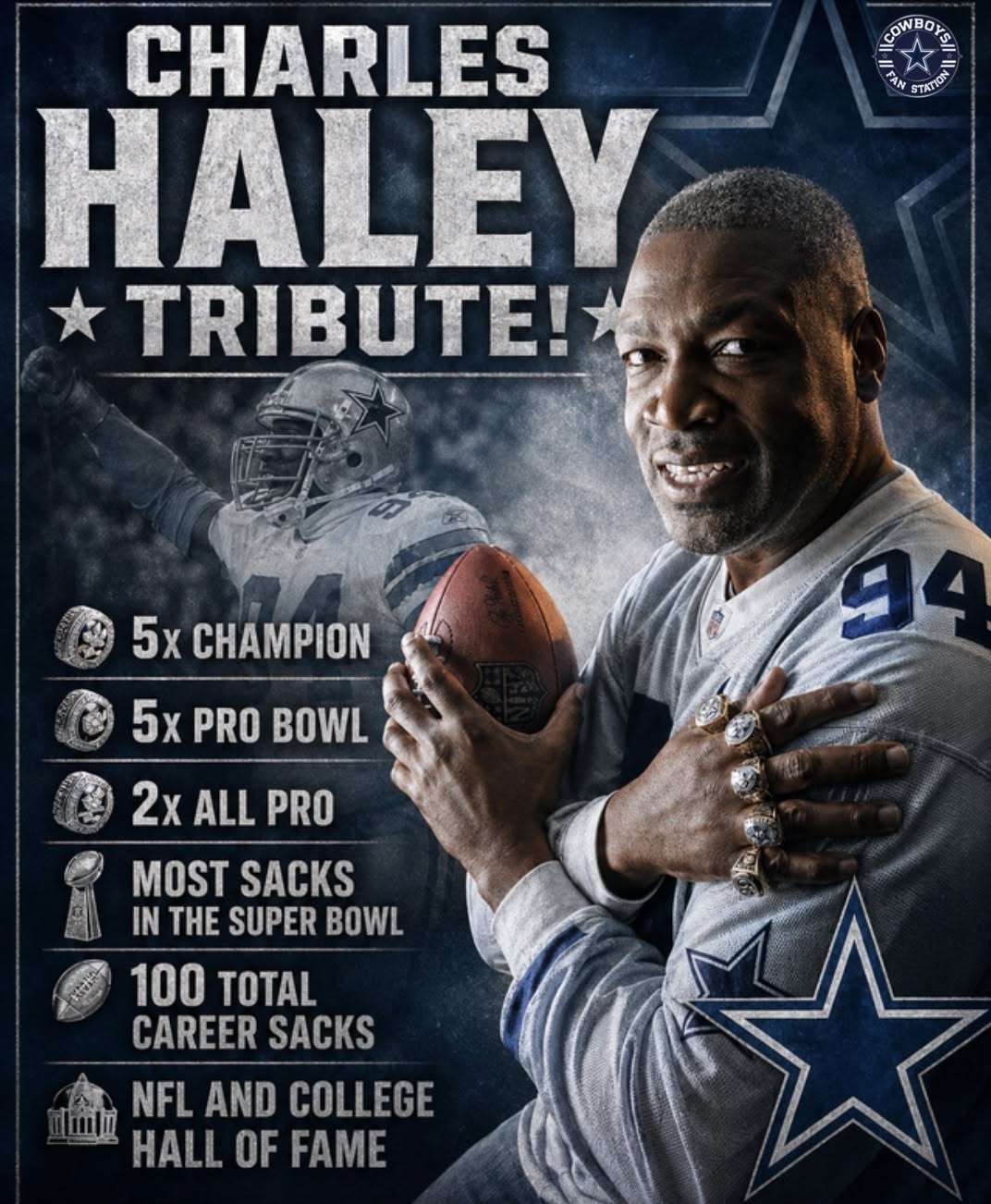
The numbers alone are enough to explain why his name remains so important. Haley finished his career with 100.5 sacks in 169 games, five Pro Bowl selections, two All-Pro honors and five Super Bowl rings. Most remarkably, he became the first player in NFL history to win five Super Bowls.
But statistics only tell part of the story.
The more fascinating question is how a player who began his career as a linebacker eventually became one of the most feared defensive ends in professional football — and how he managed to become a championship contributor for both the San Francisco 49ers and Dallas Cowboys.
That journey is what makes the Charles Haley legacy so compelling.
From a Fourth-Round Pick to an NFL Superstar
Charles Haley entered the NFL in 1986 after the San Francisco 49ers selected him in the fourth round of the NFL Draft. At the time, there was little indication that the young defender would eventually become one of the greatest defensive players in league history.
Haley began his professional career primarily as a linebacker. Yet almost immediately, he showed a skill that would define his career: the ability to reach the quarterback.
As a rookie, Haley recorded 12 sacks, an extraordinary beginning for a fourth-round selection. He continued to develop, eventually leading San Francisco in sacks in each of his first six seasons. By 1990, his pass-rushing ability had reached another level, as he produced a career-high and NFC-leading 16 sacks.
That season was more than another impressive statistical campaign.
It was a warning.
Haley was becoming the kind of defensive player opposing offensive coordinators had to account for before the game even started.
And once teams began designing game plans around him, Haley found another way to make an impact.
The San Francisco 49ers Years
Haley’s early career unfolded during a remarkable period for the San Francisco 49ers. The organization was building a culture around precision, discipline and championship expectations, and Haley quickly became an important piece of that formula.
His first six seasons with San Francisco produced four double-digit sack campaigns. He was not simply accumulating sacks in meaningless situations; his production came while playing on teams competing deep into the postseason.
Haley was part of the 49ers’ championship victories in Super Bowl XXIII and Super Bowl XXIV.
Those championships helped establish something that would eventually become the defining theme of his career: winning.
During his 12 NFL seasons, Haley was a member of 10 division championship teams. Before his final season, the fewest wins recorded by a team he played for was 10. He also appeared in six NFC Championship Games across a seven-season span.
That level of sustained team success is one reason his career deserves to be discussed whenever fans debate the greatest NFL defensive players of all time.
Yet the most important chapter of Haley’s career was still ahead.
The Trade That Changed NFL History
In 1992, Haley was traded to the Dallas Cowboys.
At first glance, changing teams after establishing himself in San Francisco might have seemed like a major risk. Instead, it became one of the most important moves of his career.
Dallas moved Haley from linebacker to defensive end, giving him a new role that allowed his pass-rushing ability to become even more dangerous. The transformation was significant.
Haley continued to pressure quarterbacks and recorded double-digit sack seasons in both 1994 and 1995, including 12.5 sacks in 1994 and 10.5 sacks in 1995.
More importantly, he became part of one of the most recognizable teams in Super Bowl history.
The Cowboys were loaded with talent, but championship teams are rarely built around offense alone. Haley gave Dallas a defensive weapon capable of changing the rhythm of an opposing offense.
And that became especially important when games reached the postseason.
Five Super Bowl Rings: A Record That Defined His Legacy
When discussing Charles Haley, one statistic inevitably dominates the conversation:
Five Super Bowl victories.
Haley won two championships with San Francisco and three with Dallas, making him the first player in NFL history to win five Super Bowls.
His championship teams included victories in Super Bowls XXIII, XXIV, XXVII, XXVIII and XXX.
This accomplishment is extraordinary because winning even one Super Bowl requires an unusual combination of talent, health, coaching, roster construction and luck.
Winning five means doing it repeatedly.
It means surviving injuries, roster changes, pressure, expectations and increasingly difficult opponents.
It means remaining valuable as football evolves around you.
That is why Haley’s Super Bowl résumé remains one of the most impressive accomplishments in professional football.
But there is another reason his five rings matter.
He did not win them all with one franchise.
He helped win championships with both the 49ers and Cowboys — two iconic NFC organizations that were competing against each other for supremacy during the same era.
That makes his career particularly unusual.
Why Charles Haley Was Such a Dangerous Defensive Player
Haley’s greatest weapon was his ability to disrupt the quarterback.
Pass rushing is not simply about speed. At the NFL level, offensive linemen are powerful, technically sound and trained to recognize defensive tendencies. A successful pass rusher needs timing, acceleration, leverage, balance and the ability to react when an offensive play does not develop as expected.
Haley possessed the physical tools to attack from the edge, but his greatest advantage was his relentless pressure.
His career total of 100.5 sacks places him among the most accomplished pass rushers of his generation. He also recorded six seasons with double-digit sacks.
His versatility made him even more valuable.
He began as a linebacker and later transitioned to defensive end. Rather than being limited to one defensive identity, Haley demonstrated that his greatest skill could translate across positions.
That adaptability is one reason his career remains relevant when analyzing the evolution of professional football.
Modern defensive schemes increasingly emphasize creating pressure through multiple fronts and disguising where the rush will come from. Haley’s career provides an earlier example of how an elite pass rusher could create problems regardless of the precise position listed next to his name.
The Numbers Behind the Legend
Haley’s career statistics paint a remarkable picture.
According to the Pro Football Hall of Fame, he played 169 games and finished with 100.5 career sacks. He also recorded five Pro Bowl selections, two All-Pro honors and two NFC Defensive Player of the Year awards.
His peak seasons were particularly impressive.
In 1986, his rookie season, he recorded 12 sacks.
In 1988, he produced 11.5 sacks.
In 1989, he added 10.5.
Then came 1990, when Haley reached his career-high mark of 16 sacks.
After moving to Dallas, he added another 12.5-sack season in 1994 and 10.5 sacks in 1995.
Those numbers reveal something important.
Haley was not a one-season phenomenon.
He maintained elite production across different teams, different defensive positions and different stages of his career.
That consistency is a major reason he belongs in conversations about the greatest NFL defensive legends.
The Road Was Not Always Smooth
The story becomes even more interesting because Haley’s career was not an uninterrupted climb.
In 1996, he suffered a serious back injury that limited him to only five games. After undergoing surgery, he retired.
For many athletes, that would have been the end.
But Haley eventually returned.
After a two-year absence, he came back to the 49ers for two postseason games in 1998. He then returned for one final season in 1999, recording three additional sacks before ending his playing career.
That comeback adds another layer to his football legacy.
He did not simply walk away after reaching the top. He attempted one more chapter.
And although the final season was not comparable to his prime, it gave Haley the opportunity to close his career on his own terms.
The Moments That Made Fans Remember
Great players are remembered through statistics, but legends are remembered through moments.
For Haley, those moments came throughout his championship years and during the countless situations when his presence forced offenses to alter their plans.
Imagine an offensive coordinator preparing for a playoff game.
The quarterback needs time.
The offensive line needs protection.
The offense needs rhythm.
Then Haley lines up across from the line.
Suddenly, the game changes.
A running back may need to stay in protection.
A tight end may be forced to help.
A quarterback may have to speed up his internal clock.
A play that originally called for a deep route may now require a quicker read.
That is the hidden value of an elite pass rusher.
A sack appears in the box score.
But the pressure before the sack may have already changed the game.
This is why Haley’s impact cannot be measured by sacks alone.
Two Teams, One Championship Mentality
One of the most fascinating aspects of Haley’s career is his connection to both the 49ers and Cowboys.
These franchises represented different identities within the NFL, yet Haley became a championship piece for both.
With San Francisco, he helped win two Super Bowls.
With Dallas, he helped win three more.
That means Haley was not simply present during a successful era. He was a meaningful contributor to multiple championship teams.
The Pro Football Hall of Fame notes that he played in six NFC Championship Games over a seven-season stretch, starting for San Francisco in 1988, 1989 and 1990 and later starting for Dallas in the 1992, 1993 and 1994 conference championship games.
That level of postseason consistency is extraordinary.
And it helps explain why his career is still frequently discussed whenever fans revisit the greatest teams of the 1980s and 1990s.
Charles Haley and the Evolution of the Pass Rush
The NFL has changed dramatically since Haley’s playing days.
Offenses are now more spread out. Quarterbacks often operate in shotgun formations. Passing concepts have become more sophisticated, and defensive coaches constantly search for creative ways to generate pressure.
Yet one principle has remained unchanged:
If a defense can consistently pressure the quarterback, it can control the game.
Haley represented that principle at an elite level.
He could win with speed, power and explosiveness, while his versatility allowed him to operate from different positions.
That is why younger generations of football fans can still learn from studying his career.
The uniforms change.
The formations change.
The terminology changes.
But elite pass rushing remains one of the most valuable skills in professional football.
Why His Hall of Fame Career Matters
Charles Haley was inducted into the Pro Football Hall of Fame as part of the Class of 2015.
The honor confirmed what his career statistics had already suggested: Haley was not merely a successful player.
He was historically significant.
Five Super Bowl rings.
100.5 sacks.
Five Pro Bowls.
Two All-Pro selections.
Two NFC Defensive Player of the Year awards.
Ten division championships.
Six NFC Championship Game appearances across seven seasons.
Those accomplishments place Haley firmly among the most accomplished NFL legends.
But perhaps the strongest argument for his legacy is the combination of individual dominance and team success.
Many defensive players accumulate extraordinary statistics without winning championships.
Others win championships while playing smaller roles.
Haley managed to do both.
The Legacy of a Relentless Competitor
When fans discuss NFL history, the conversation often centers on quarterbacks, wide receivers and offensive records.
But football is ultimately a team sport.
Defensive players can determine the identity of a championship team just as much as offensive stars.
Charles Haley represents that idea perfectly.
His career was built around pressure, intensity and the relentless pursuit of winning.
He played linebacker.
He played defensive end.
He played for San Francisco.
He played for Dallas.
He dealt with injury.
He retired.
He came back.
And through all of those chapters, he remained connected to winning football.
His five Super Bowl victories remain the headline achievement, but his 100.5 sacks and sustained postseason success provide the deeper context.
That combination is what makes his football legacy so difficult to replicate.
Charles Haley’s Place Among NFL Legends
So where should Charles Haley rank among the greatest defensive players in NFL history?
There is no single answer.
Every era produces different styles, schemes and statistical environments. Comparing defensive players across generations is complicated because their responsibilities are not always identical.
But Haley’s résumé gives him a strong case.
He was an elite pass rusher.
He was versatile.
He produced at a high level for multiple teams.
He played on championship rosters.
He delivered over a long career.
And, most importantly, he consistently found himself at the center of winning football.
The Pro Football Hall of Fame’s record of five Super Bowl rings is perhaps the simplest way to understand his unique place in Super Bowl history.
Yet the number five does not tell the entire story.
The real story is everything Haley had to overcome and everything he contributed along the way.
The Part of Charles Haley’s Story Fans Often Forget
When a player’s career becomes legendary, it is easy to reduce everything to numbers.
Five rings.
One hundred sacks.
Two Defensive Player of the Year awards.
Five Pro Bowls.
But behind those numbers was a player who spent years competing at the highest level of professional football while carrying enormous expectations.
His career included a dramatic transition from linebacker to defensive end, a major trade, championship pressure, injury, retirement and eventual return.
That journey is why Charles Haley remains more than a name in a record book.
He is part of the story of how an era of professional football was won.
And perhaps that is the most compelling part.
Because when people remember the great 49ers and Cowboys teams of that era, they often remember the quarterbacks, offensive stars and iconic moments first.
But standing on the other side of the line was Charles Haley.
Waiting.
Pressuring.
Chasing.
Changing the game one snap at a time.
Final Thoughts: A Legacy That Still Stands
Charles Haley’s career is a reminder that greatness in the NFL can take many forms.
Some players are remembered for statistics.
Others are remembered for championships.
Some are remembered for one unforgettable season.
Haley managed to build a legacy around all three.
His 100.5 career sacks, five Super Bowl victories, five Pro Bowl selections and two NFC Defensive Player of the Year awards provide the statistical foundation.
His time with the San Francisco 49ers and Dallas Cowboys provides the championship story.
And his ability to reinvent himself as a defensive end after beginning his career at linebacker provides the competitive story.
Together, those chapters create something much bigger: a genuine NFL legend.
For fans who love NFL history, Super Bowl history and the greatest defensive players to ever step onto the field, Charles Haley’s career remains one of the most fascinating stories to revisit.
And there is still more to the story.
From his most dominant seasons to the championship moments that helped define two legendary franchises, the details behind Haley’s career reveal just how extraordinary his impact really was.
Để lại một bình luận