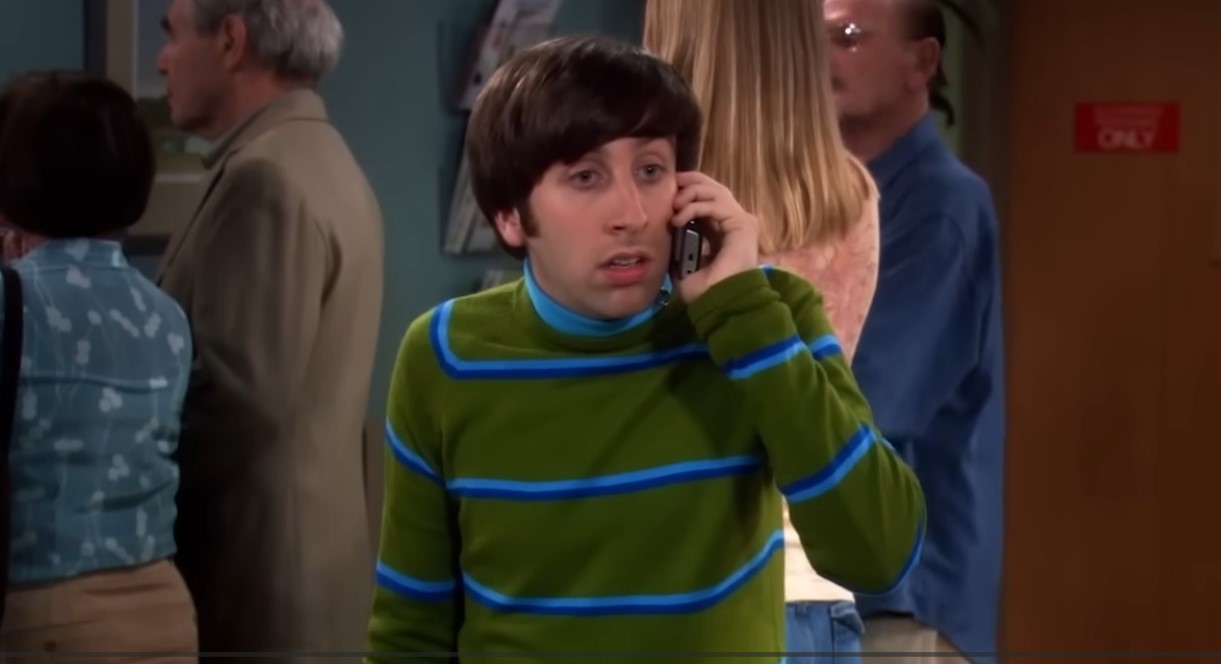
There are moments in long-running television that feel ordinary until they suddenly aren’t. A living room. A familiar couch. The soft click of a refrigerator door. Two physicists and one former waitress who has somehow become the emotional center of gravity for an entire friend group. On the surface it looks like any other evening in the apartment that audiences watched for twelve seasons. Yet the second Sheldon Cooper opens his mouth, the temperature of the room changes. What follows is not a loud argument or a dramatic confrontation. It is something quieter, sharper, and far more revealing.
Sheldon has always been a man of rigid systems. His life is a carefully constructed lattice of routines, rules, and non-negotiable preferences. When he decides to alter one of those systems, the decision rarely arrives with warning. It simply appears, fully formed, delivered in that calm, slightly superior tone that has become his signature. On this particular night the announcement lands with unusual force. Leonard Hofstadter, the man who has spent years translating Sheldon’s logic into something the rest of the world can survive, is left without words. His face does the thing it always does when the universe refuses to cooperate with his expectations. The jaw slackens. The eyes widen. The brain, usually so quick with a defensive quip, goes completely offline.
And that is the exact second Penny becomes the most important person in the frame.
She does not need a monologue. She does not need to raise her voice. A single shift in posture, a look that lasts half a second longer than it should, the smallest intake of breath—those are the tools she uses, and they are devastatingly effective. In a media landscape obsessed with celebrity Hollywood spectacle and carefully staged emotional peaks, Penny’s reaction feels almost rebellious in its restraint. She is not performing. She is simply present, reading the subtext the two men are still scrambling to process. That presence steals the entire moment.
The apartment itself seems to hold its breath. Soft practical lighting, the kind productions chase when they want audiences to feel at home, now feels heavier. The space that once hosted countless debates about soft versus hard science, comic-book continuity, and the proper temperature of soup has become a quiet pressure chamber. Sheldon remains composed, as if he has merely corrected a minor scheduling error rather than introduced a variable that could rearrange the delicate balance of their shared lives. Leonard is still catching up. Penny is already three moves ahead.
What makes the sequence linger is the gap between what is said and what is felt. Sheldon’s decision, whatever its precise shape, carries the weight of someone who almost never changes course. Every deviation from his established path therefore feels seismic. Leonard understands this better than anyone. He has built his adult life around predicting, absorbing, and occasionally mitigating the aftershocks of Sheldon’s choices. When the buffer himself is left speechless, the moment carries extra gravity. Viewers who have followed the series know that silence from Leonard is never empty. It is dense with calculation, with memory, with the accumulated history of previous decisions that upended dinners, holidays, and carefully protected weekends.
Penny’s reaction refuses to let the scene become purely about the two physicists. In an entertainment culture that often sidelines the non-scientist characters, her presence insists on emotional truth. She has watched these men navigate breakthroughs and breakdowns for years. She has cleaned up the metaphorical messes. She has rolled her eyes, poured wine, and delivered the kind of blunt honesty that no amount of academic training can prepare a person for. When she reacts, the audience leans in because they recognize the look. It is the look of someone who has already calculated the human cost while the others are still arguing about the principle.
There is something almost photographic about the composition of the three of them in that room. Think of classic film history frames where the most important information lives in the spaces between the characters. Think of vintage culture photographs that freeze a single expression and somehow contain an entire novel. The soft light catches Leonard’s glasses. Sheldon’s posture remains perfectly upright. Penny occupies the emotional center without ever demanding it. Women’s lifestyle storytelling has long understood the power of the reaction shot. A raised eyebrow can dismantle an argument. A soft exhale can communicate years of shared history. In this moment Penny does both, and more.
The comedy, of course, is still present. The Big Bang Theory has always thrived on the gap between intellectual brilliance and emotional incompetence. Yet beneath the familiar rhythms sits something more layered. These people have become family. Family decisions, no matter how idiosyncratically delivered, carry real stakes. Sheldon’s announcement is not a casual preference. It is a shift that will ripple outward—into group dinners, into late-night conversations, into the quiet moments when Leonard and Penny are finally alone and free to process what just happened without Sheldon’s particular brand of logic dominating the air.
Leonard eventually finds fragments of language again. The words arrive slowly, carefully, as if he is testing the structural integrity of each syllable before releasing it. Sheldon listens with that familiar mixture of patience and mild impatience, already several steps ahead in his own internal chronology. Penny continues to hold the space between them, the unofficial translator who never applied for the job but somehow became indispensable to it. The tension does not explode. It simmers. That simmer is where the real storytelling lives.
Consider the broader cultural context. Celebrity Hollywood has spent decades packaging friendship and romance into neat, marketable packages. Film history is filled with stories of brilliant minds who could solve the universe’s greatest puzzles but could not navigate a simple conversation about feelings. Photography from earlier eras often captured those exact contradictions: the genius lost in thought, the observer watching him with a mixture of affection and exasperation, the room that somehow feels both intimate and impossibly large. Vintage culture understood the power of the unspoken. Entertainment at its best does not simply deliver punchlines. It delivers the moment after the punchline, when the characters and the audience both realize the ground has shifted.
In this scene the ground has most certainly shifted. The decision Sheldon has made will not resolve in a single living-room conversation. It will echo. It will force every character to re-evaluate their place in the constellation they have built together. Leonard’s temporary muteness is not mere surprise. It is the temporary shutdown of a man who has spent years serving as the human interface between Sheldon and the rest of reality. Penny’s reaction becomes the emotional center of gravity because she is the only one still fully present in the room. She is not calculating probabilities. She is registering the human cost in real time.
Small details begin to accumulate as the conversation continues. The way Sheldon’s hands remain still at his sides. The way Leonard’s shoulders drop a fraction when he finally accepts that the old script no longer applies. The way Penny’s expression softens just enough to signal that she is prepared to absorb whatever comes next. These are the textures that turn a sitcom beat into something memorable. They are also the textures that keep audiences returning long after the final episode aired. Because underneath the Bazinga catchphrases and the endless debates about physics lies a simple truth: these characters matter to each other in ways they are still learning how to express.
There is a particular satisfaction in watching Penny hold that emotional space. In a series that often prioritizes male friendships and scientific rivalries, her ability to cut through the noise feels like a quiet act of reclamation. She does not need to announce that she sees the bigger picture. The audience already knows she does. That quiet authority is what makes her reaction the true centerpiece of the sequence. It is not loud. It is not theatrical. It is simply true.
Meanwhile the implications continue to unfold. Decisions of this magnitude do not stay contained inside one apartment. They travel. They affect Amy. They affect the rest of the group. They affect the carefully maintained routines that keep Sheldon’s world from collapsing into chaos. Leonard understands this better than anyone, which is why his speechlessness carries extra weight. He has survived Sheldon’s various phases—the train schedules, the food prohibitions, the social experiments conducted without consent. Yet every time he thinks he has developed immunity, a new variable appears. This time the variable has left him temporarily without language, and that muteness becomes its own form of commentary.
The apartment feels different after the announcement. Or perhaps the people inside it simply see it differently. The walls have not moved, but the emotional architecture has. Sheldon remains largely unaffected by the weather he has created. That is part of his enduring charm and his enduring challenge. He delivers life-altering information with the same tone he might use to correct someone’s misuse of a scientific term. The disconnect is where the comedy lives, but it is also where the heart of the series has always resided. Over twelve seasons these people learned, imperfectly and often reluctantly, how to love one another across that disconnect.
As the scene draws toward its close, the curiosity only intensifies. What does Sheldon’s decision actually mean for the carefully balanced ecosystem of their lives? How will Leonard ultimately respond once the initial paralysis wears off? And what, precisely, is Penny already anticipating that the two physicists have not yet allowed themselves to consider? The answers are not fully contained in the visible moment. They live in the spaces between the lines, in the looks that last half a second longer than necessary, in the silence that follows Sheldon’s calm declaration.
That silence is where the real story lives. It is the pause that lets the audience lean forward. It is the moment that transforms a simple sitcom beat into something that feels closer to classic storytelling—the kind that photography and vintage culture have always tried to capture in a single frame. It is the reason people keep returning to these characters. Because in a world of celebrity Hollywood excess and carefully curated entertainment, there is still something magnetic about three people in an apartment, one of them delivering news that changes the temperature of the room, another left temporarily without language, and the third reacting with a clarity that steals everything.
The story does not end when the scene cuts. It continues in the unanswered questions, in the implications still unfolding, in the quiet certainty that the next conversation between these three will carry the weight of everything that just occurred. And somewhere in that continuation lies the detail that makes the whole sequence linger—the one element the camera almost missed, the one reaction that still has more to say. The ending, as it turns out, is still arriving.
Để lại một bình luận