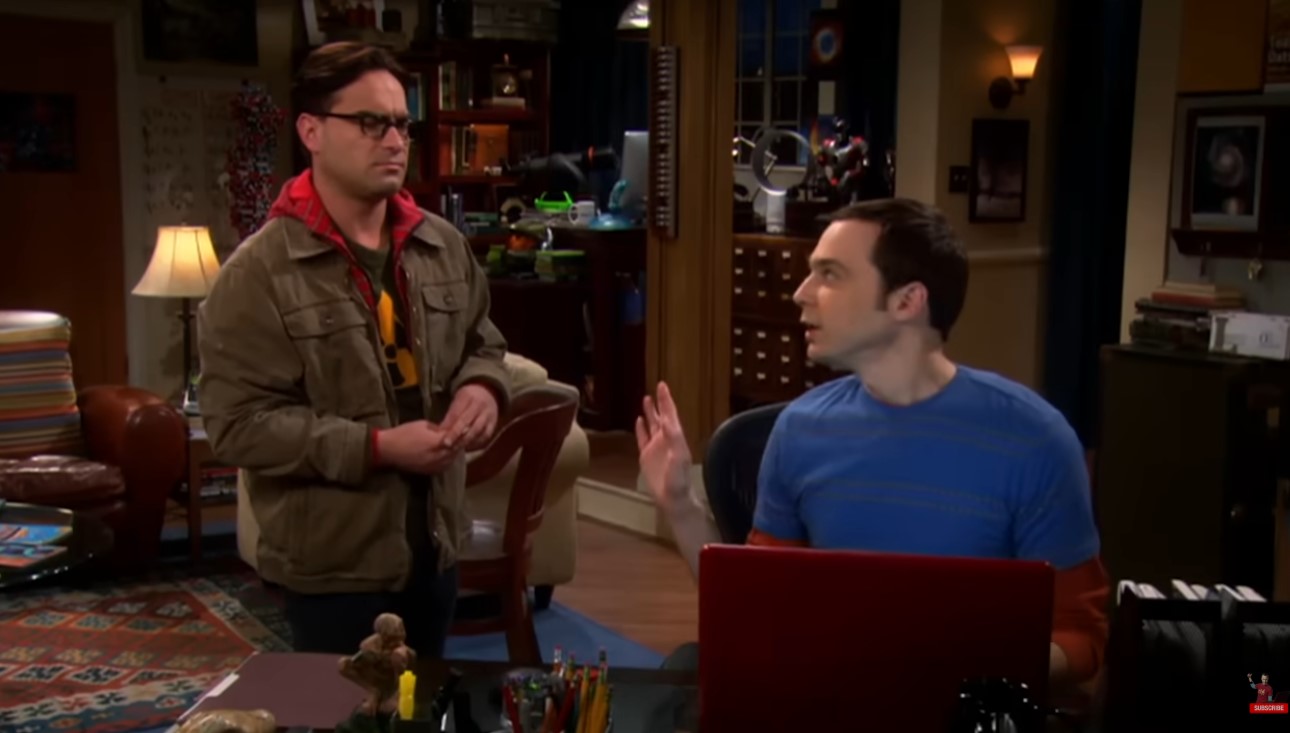
At 2:17 in the morning, Leonard Hofstadter woke to the sound of someone knocking on a door that, as far as he knew, did not exist.
The sound came again.
Three slow knocks.
Not from the hallway. Not from Penny’s apartment. Not from the elevator. The noise seemed to travel through the walls themselves, as though someone on the other side of the building had discovered a hidden passage and was patiently waiting for Leonard to notice.
He sat upright in bed, his glasses somewhere on the nightstand, his heart beating faster than any reasonable scientific explanation could justify. For several seconds he simply listened to the darkness. The apartment was unusually still. Even the refrigerator seemed to have stopped humming.
Then came a fourth knock.
Leonard reached for his glasses.
And that was when he noticed the envelope lying beneath the bedroom door.
It was black.
There was no name on it.
Only one sentence, written in silver ink.
You were never supposed to remember the room.
For Leonard, who had spent most of his adult life believing that every mystery could eventually be reduced to evidence, equations and sufficient amounts of coffee, the sentence was disturbing for one simple reason.
He had no memory of any room.
At least, none that he could explain.
By sunrise, the envelope was still on the kitchen table, untouched except for the fingerprints Leonard had left around its edges. He had spent three hours convincing himself that the message was a prank. Perhaps Howard had organized it. Perhaps Sheldon had created some elaborate psychological experiment. Perhaps Penny had discovered a way to manipulate her husband into getting out of bed at an unreasonable hour.
But none of those explanations survived the second piece of evidence.
At 7:41 that morning, Sheldon Cooper walked into the apartment, took one look at the envelope and stopped breathing for approximately two seconds.
For Sheldon, two seconds was practically a confession.
Leonard noticed immediately.
“You’ve seen this before.”
Sheldon did not answer.
Outside, Pasadena was beginning another ordinary morning. Cars moved beneath the pale California sunlight. A delivery truck groaned around the corner. Somewhere in the building, someone dropped a metal pan, and the sharp crash echoed through the stairwell.
Inside Apartment 4B, however, the past had quietly entered the room.
And Sheldon was looking at it.
Not with curiosity.
With fear.
That was what frightened Leonard most.
Years earlier, Leonard had learned that Sheldon could react to almost anything with intellectual arrogance. He could dismiss emotional situations, social conventions and even obvious danger if doing so allowed him to preserve the internal architecture of his worldview.
But this was different.
Sheldon reached toward the envelope and stopped before touching it.
“Where did you get that?”
“I woke up and it was under my door.”
“Who else knows?”
“Nobody.”
Sheldon stared at the silver sentence again.
Then, almost inaudibly, he said, “That’s not possible.”
The words remained suspended between them.
Leonard felt the familiar sensation of an old friendship becoming something more complicated. He had spent years living beside Sheldon, arguing with him, defending him, forgiving him and occasionally wondering whether friendship with a theoretical physicist who treated social interaction like an experimental inconvenience was itself a form of psychological endurance.
Yet Leonard had always believed there was one thing Sheldon would never hide from him.
The truth.
Apparently, he had been wrong.
Later that morning, Penny arrived carrying coffee and the expression of someone who had already decided that whatever was happening was probably going to become her problem.
Sheldon barely acknowledged her.
Penny looked at Leonard.
Then at the envelope.
Then back at Leonard.
“Okay,” she said slowly. “Why does your kitchen look like the beginning of a really bad horror movie?”
Leonard tried to smile.
“It isn’t a horror movie.”
Sheldon finally looked up.
“Technically, we don’t have sufficient evidence to classify the genre.”
Penny’s eyes narrowed.
“That wasn’t the reassuring answer.”
For years, Penny had been the person who could walk into a room and change its emotional temperature without knowing how she had done it. She had learned that science was sometimes a language Leonard spoke when he was afraid, that sarcasm was often Sheldon’s armor, and that silence could mean more than either of them wanted to admit.
She picked up the envelope.
Sheldon immediately stopped her.
“Don’t.”
The single word carried enough force to make her freeze.
Penny slowly placed it back on the table.
“What is this?”
Sheldon looked toward the window.
“I don’t know.”
Leonard stared at him.
“You just said it wasn’t possible.”
“I said the existence of the object was impossible. I did not say I understood it.”
Penny folded her arms.
“That’s basically the same thing.”
“No, it isn’t.”
“It is when you’re being creepy.”
For a moment, nobody spoke.
Then Penny noticed something Leonard had missed.
There was a tiny symbol in the lower-right corner of the envelope.
A circle.
Inside it was a star.
And beneath the star were four numbers.
04.12
Penny’s expression changed.
“Leonard.”
He looked at her.
She pointed.
“That date.”
Leonard’s stomach tightened.
He knew it.
Not consciously.
Not completely.
But somewhere deep inside his memory, behind years of birthdays, experiments, arguments, weddings, career disappointments and impossible conversations, the numbers had been waiting.
April 12.
The date Leonard had first moved into the apartment.
Except that wasn’t what made his hands go cold.
There was another April 12.
One nobody talked about.
One Leonard had forgotten.
Or perhaps one he had been taught to forget.
The story began to unfold that afternoon when Leonard found an old photograph inside a box he had not opened since his early years at the university.
The photograph was faded.
Its edges had curled from age.
It showed a hallway.
The hallway of their apartment building.
But the picture had been taken before Leonard had ever lived there.
He knew that because the carpet was different.
The walls were different.
And, most unsettling of all, there was a door between Apartments 4A and 4B.
A door that no longer existed.
Leonard turned the photograph over.
On the back was a handwritten note.
Sometimes buildings remember what people forget.
The sentence made him laugh nervously.
Then he stopped laughing.
Because the handwriting looked familiar.
It was his own.
The discovery should have been impossible.
Instead, it became the first crack in a story that would take Leonard, Sheldon and Penny into a forgotten corner of their own lives.
That evening, they sat around the dining table while the city outside dissolved into blue twilight. The apartment lights remained off. Only the warm glow from Pasadena’s streetlamps entered through the windows, turning the room into something that looked less like a modern apartment and more like an old Hollywood set waiting for actors to arrive.
Penny studied the photograph.
“I don’t remember that door.”
Sheldon corrected her automatically.
“You couldn’t remember something you never saw.”
She looked at him.
“You’re really not helping.”
Sheldon ignored the comment.
He had begun researching the building’s architectural history.
Within an hour, he had discovered that the apartment complex had undergone renovations decades earlier after an electrical fire. Several interior walls had been reconstructed. A service corridor had been sealed.
But there was no record of a room.
No official blueprint showed it.
No property archive mentioned it.
And yet the photograph existed.
That was when Sheldon found something else.
A newspaper clipping.
The image was tiny, grainy and almost entirely consumed by shadows.
It showed a group of young university students standing outside the building in the late 1980s.
Among them was a man Sheldon recognized immediately.
Professor George Smoot.
But there was something else in the photograph.
A woman stood behind the group.
Her face was partially hidden.
She was holding a camera.
And on the camera strap was the same symbol as the one on Leonard’s envelope.
The circle.
The star.
04.12.
Penny leaned closer.
“Who is she?”
Sheldon zoomed the image until the pixels began to collapse.
“I don’t know.”
Leonard stared at the woman’s silhouette.
“I think I do.”
Both of them turned.
He could not explain why.
The recognition was not visual.
It was emotional.
Like hearing a song from childhood and suddenly remembering the room where you first heard it.
“She was in my mother’s research.”
That sentence changed everything.
Leonard’s mother, Beverly Hofstadter, had built her career around psychology, observation and human behavior. Her relationship with Leonard had always been complicated. She had viewed emotion as something that could be analyzed, measured and categorized.
But Leonard suddenly remembered something she had once told him when he was a child.
There were memories people carried because they happened.
And there were memories people carried because someone else wanted them to.
At the time, Leonard had assumed she was speaking theoretically.
Now he wondered.
Penny reached for his hand.
It was a small gesture.
Almost invisible.
But Leonard felt it.
For years, he had been the person who overanalyzed everything. A raised eyebrow could become a hypothesis. A pause in conversation could become evidence. A strange text message could keep him awake for hours.
Penny knew that.
She squeezed his hand.
“Whatever this is,” she said quietly, “you don’t have to figure it out alone.”
Leonard looked at her.
The sentence was simple.
But something inside him broke open.
Not dramatically.
Not like in the movies.
There was no orchestral music.
No sudden revelation.
Just a quiet realization that perhaps love was not about finding someone who understood every part of your mind.
Perhaps it was about finding someone willing to sit beside you while you tried to understand it yourself.
Across the table, Sheldon looked away.
For once, he did not make a joke.
Instead, he picked up the photograph.
“I think we should find the room.”
The next morning, they entered the building’s basement.
The fluorescent lights flickered overhead.
Dust moved through the narrow corridors whenever the ventilation system activated, creating tiny spirals that looked almost like smoke.
The old service passage was behind a wall covered with maintenance equipment.
Sheldon had calculated the dimensions.
Leonard had compared them with the original photograph.
Penny had simply noticed a scratch on the floor.
The scratch led directly toward the wall.
“There’s something behind it,” she said.
Sheldon stared.
“That is not sufficient evidence.”
Penny pointed.
“Then explain why the floor is scratched in a straight line toward a wall that supposedly isn’t hiding anything.”
Sheldon crouched.
For once, he said nothing.
The three of them began moving equipment.
Behind the wall was an old metal door.
No handle.
No lock.
Only the same circle-and-star symbol.
Leonard touched it.
The lights went out.
For several seconds, there was absolute darkness.
Then a projector started.
A rectangle of pale light appeared on the opposite wall.
Old film began moving through the machine.
The image was black and white.
Grainy.
Beautiful.
It showed the apartment building decades earlier.
Students walked through the hallways.
A young professor laughed.
Someone carried books.
Someone else adjusted a camera.
Then the film showed a small group gathered inside the hidden room.
Among them was the woman from the photograph.
Leonard stepped closer.
She was holding a notebook.
On the wall behind her was a simple equation.
Not a famous equation.
Not something revolutionary.
It was a probability calculation.
The probability of two strangers meeting.
The probability of friendship.
The probability that two people with completely different personalities would eventually become important to each other.
Leonard’s eyes widened.
“That’s…”
Sheldon finished the sentence.
“A model.”
The film continued.
The woman spoke, but the audio was almost completely gone.
Only fragments survived.
“…people believe coincidence…”
“…but environments influence choices…”
“…sometimes you build a room…”
The film jumped.
Static.
Then another image appeared.
A young man.
Leonard.
Much younger.
Standing outside the apartment building.
He was perhaps eleven or twelve.
Beside him stood Beverly.
Leonard stopped breathing.
“I’ve never been here.”
Penny looked at him.
“You don’t remember?”
“No.”
On the screen, young Leonard turned toward his mother.
Beverly said something.
The audio was too damaged to understand.
Then she handed him a small photograph.
The same photograph Leonard had found years later.
The film ended.
The projector continued clicking in the darkness.
No one spoke.
Then Sheldon said something so softly that Leonard almost missed it.
“Your mother knew.”
Leonard turned.
“Knew what?”
Sheldon looked at the empty screen.
“That you would eventually live here.”
The room seemed to contract around them.
Leonard shook his head.
“That’s impossible.”
“Yes.”
Sheldon looked at him.
“That’s what makes it interesting.”
Penny walked toward the projector.
She found another reel.
This one had a handwritten label.
THE FOURTH VARIABLE.
Sheldon stared at it.
Then he smiled.
Not his usual triumphant smile.
Something quieter.
Something almost sad.
“What?”
Leonard asked.
Sheldon held the reel carefully.
“I think I know what this is.”
He explained that the woman in the film had been part of an experimental interdisciplinary project exploring environmental psychology. The researchers believed that architecture, proximity and repeated encounters could influence relationships.
The project had never been published.
It had been abandoned.
The room had been sealed.
The records disappeared.
But someone had preserved the film.
And someone had deliberately left clues for Leonard.
The mystery, however, was not why the room existed.
The mystery was why Leonard had been there as a child.
Then Penny noticed the date.
04.12.
She looked at Leonard.
“That’s not the day you moved into the apartment.”
“No.”
Sheldon looked at the photograph.
“It’s the day you first saw this building.”
Leonard closed his eyes.
And suddenly, something returned.
A smell.
Old carpet.
Rain.
His mother’s perfume.
A distant piano playing through an open window.
And her voice.
Not clear.
But close.
One day, you’ll come back here.
Leonard opened his eyes.
Penny was watching him.
“What did she say?”
He swallowed.
“She said I’d come back.”
The room became silent.
Outside, a siren passed somewhere in the distance.
Then another sound followed.
Footsteps.
Someone was walking toward them from the hallway.
Slowly.
Deliberately.
Sheldon turned off the projector.
The room disappeared into darkness.
The footsteps stopped outside the door.
Nobody moved.
Then came three knocks.
The same three knocks Leonard had heard at 2:17 in the morning.
Penny’s fingers tightened around Leonard’s.
Sheldon whispered, “Nobody speaks.”
The door opened.
A woman stood in the hallway.
Older now.
Her hair was silver.
She carried a vintage camera.
The same model seen in the old photograph.
She looked at Leonard.
Then at Sheldon.
Then at Penny.
And smiled.
“I was beginning to wonder when you would find it.”
Leonard felt the entire past shift beneath his feet.
“Who are you?”
The woman raised the camera.
For a moment, the tiny metal lens caught the light.
“My name doesn’t matter.”
She stepped into the room.
“What matters is that your mother was wrong about one thing.”
Leonard stared.
“What?”
The woman looked at Penny.
Then at Sheldon.
Then back at Leonard.
“You weren’t meant to come back alone.”
No one moved.
The sentence seemed to echo through the room.
And suddenly Leonard understood why the envelope had appeared.
Why the photograph had survived.
Why the room had remained hidden.
It had never been about an experiment.
It had never been about predicting friendship.
It had been about witnessing it.
The woman placed the old camera on the table.
“Your mother believed people could be studied from a distance,” she said. “I disagreed.”
Leonard listened.
“I believed the most important things in human life happen when nobody is taking notes.”
Penny glanced at Sheldon.
Sheldon looked strangely uncomfortable.
The woman smiled.
“Friendship. Love. Forgiveness. The moment someone decides not to leave.”
Leonard felt his throat tighten.
The woman continued.
“Those things cannot be measured properly because the act of observing them changes them.”
Sheldon slowly nodded.
“Quantum mechanics.”
“Not exactly.”
“But metaphorically.”
“Close enough.”
For the first time that night, Penny laughed.
It was quiet.
Almost nervous.
But it broke the tension.
And Leonard realized something.
The mystery had never really been about the room.
It had been about the question hidden inside it.
Why do people find each other?
Why do some friendships survive years of disagreement?
Why does one person walk into a room and change another person’s entire life?
Why does a woman who once seemed impossibly distant become home?
Why does someone who once seemed unbearable become family?
Science could describe the forces.
Psychology could describe the patterns.
Film could capture the expression.
Photography could freeze the moment.
But none of them could fully explain what happened between people.
That was the secret.
The one the room had been waiting decades to reveal.
Later that night, the three of them returned upstairs.
Pasadena looked different from the balcony.
The city lights shimmered beneath them like thousands of tiny stars.
Penny leaned against the railing.
Sheldon stood beside her.
Leonard watched them both.
For years, he had believed the most important moments of his life would involve scientific discovery.
Perhaps that was why the universe had played such a strange joke on him.
His greatest discoveries had never been equations.
They had been people.
The woman he loved.
The friends who stayed.
The arguments that somehow became memories.
The awkward dinners.
The ridiculous games.
The impossible conversations.
The moments when someone knocked on a door and changed everything.
Penny looked at him.
“You okay?”
Leonard smiled.
“I think so.”
Sheldon glanced toward the hallway.
“You know, statistically, the probability of the three of us becoming friends was extremely low.”
Penny smiled.
“Yeah?”
“Extremely.”
Leonard laughed.
“And yet here we are.”
Sheldon considered this.
Then, with unusual sincerity, he said, “Perhaps the probability was never the important part.”
Nobody answered.
They didn’t need to.
Behind them, inside the apartment, the old photograph remained on the table.
The hidden room was still there.
The camera still waited.
And somewhere in the darkness, the projector still held one final reel they had not watched.
On its label were four words.
THE LAST VARIABLE: LOVE.
Leonard did not know what the film contained.
Sheldon did not know either.
Penny had already decided they should watch it tomorrow.
Tomorrow.
Not tonight.
Because sometimes the most important stories are not the ones that reveal everything immediately.
Sometimes the mystery is what keeps people together long enough to discover the answer.
And as the three friends stood beneath the California night sky, none of them noticed the small red light blinking on the vintage camera behind them.
It was recording.
And for the first time in decades, someone was finally watching.
Not from a laboratory.
Not from behind a scientific observation window.
But from inside the story itself.
Để lại một bình luận