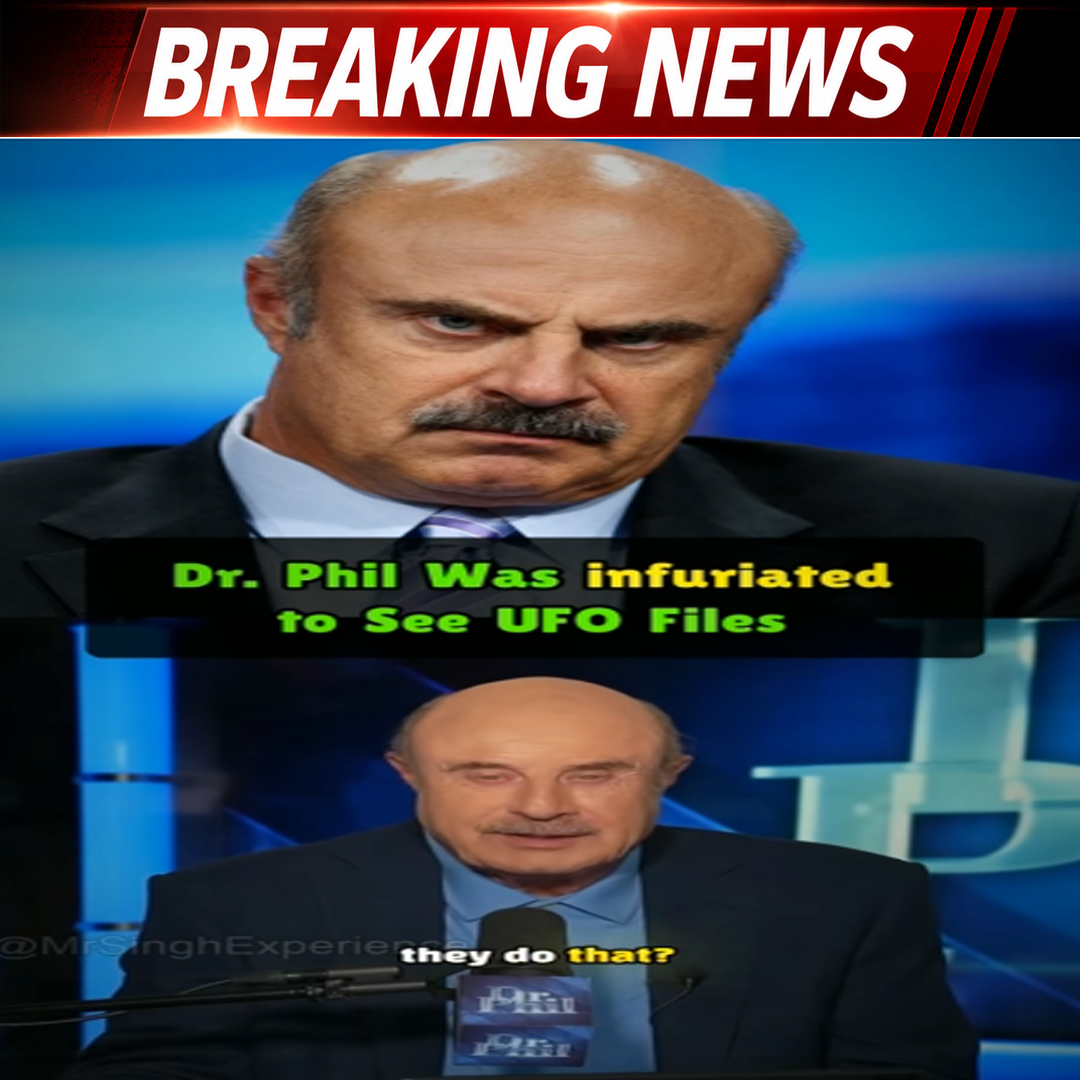
Dr. Phil Says He Read Classified UFO Files Before the Public Ever Could
For decades, conversations about UFOs, government secrets, and alien disclosure have lived somewhere between science, mystery, and conspiracy. Yet in recent years, the topic has steadily moved from fringe discussions into mainstream headlines. Congressional hearings, military footage, and testimony from former intelligence officials have all contributed to a growing belief that something extraordinary may be hidden behind decades of official silence.
Now another familiar public figure has entered the conversation.
According to Dr. Phil, he received a remarkable invitation from the White House. He claims officials asked him to review classified UFO documents before they became available to the general public. It wasn’t simply another celebrity meeting or political event. Instead, he describes an experience that left him deeply frustrated—and convinced that the American people deserve far greater transparency.
What exactly did he see?
That remains one of the biggest unanswered questions, and the most intriguing details may still be waiting to emerge.
Why Would the White House Invite Dr. Phil?
The first mystery isn’t what was inside the classified files.
It’s why someone like Dr. Phil would be invited to see them at all.
As one of America’s most recognizable television personalities, Dr. Phil has spent years interviewing public officials, experts, and everyday people about difficult issues. His influence reaches millions of viewers, making him an unusual—but potentially powerful—voice in conversations that extend far beyond psychology.
If his account is accurate, the invitation itself raises fascinating questions.
Was the meeting intended to prepare influential communicators for future public disclosure?
Was it part of a broader effort to build public trust?
Or was there another purpose that has yet to be explained?
Those questions continue to fuel speculation, and the deeper story may not yet have been fully revealed.
Dr. Phil’s Emotional Reaction Wasn’t Fear—It Was Anger
Perhaps the most surprising part of Dr. Phil’s account wasn’t excitement.
It wasn’t disbelief.
It wasn’t even shock.
Instead, he says his dominant emotion was anger.
According to his statements, the frustration came from what he perceived as decades of unnecessary secrecy surrounding unidentified aerial phenomena (UAP), the modern government term often used instead of UFO.
His reaction suggests that the information itself wasn’t as unsettling as the realization that significant evidence may have been withheld from the public for generations.
If that’s true, the real mystery isn’t simply whether unexplained objects exist.
The bigger question becomes why information remained hidden for so long—and whether the full explanation has still not surfaced.
The Long Shadow of Government Secrecy
Government secrecy surrounding UFO investigations is nothing new.
For more than seventy years, researchers have pointed to classified military reports, intelligence documents, and internal memoranda suggesting officials took the phenomenon far more seriously than public statements implied.
Many of those documents remained hidden for decades before eventually being released through declassification efforts.
Each newly released file answered a few questions while creating many more.
Some reports dismissed sightings as weather balloons or experimental aircraft.
Others openly admitted investigators simply couldn’t explain what witnesses observed.
That distinction continues to shape today’s debate.
If authorities genuinely lacked explanations in certain cases, then the mystery may be larger than many previously believed.
And according to some observers, we’re still only seeing part of the picture.
Lieutenant General Nathan Twining’s Historic Memo
One document frequently discussed in UFO history involves Lieutenant General Nathan Twining.
In 1947, Twining reportedly authored a memorandum stating that the reported phenomenon was “something real and not visionary or fictitious.”
Those words have become central to decades of debate.
Supporters argue the memo demonstrates that senior military leadership viewed the phenomenon as genuine.
Skeptics respond that recognizing unidentified objects doesn’t automatically imply extraterrestrial origins.
Both interpretations leave an important gap.
If respected military leaders believed something unexplained was occurring, what additional evidence led them to that conclusion?
That missing context continues to attract historians, investigators, and curious readers alike.
The Air Force’s Public Position
While historical documents have fueled curiosity, official public messaging often appeared very different.
For years, critics argued that various government agencies minimized or dismissed public concern over UFO reports.
Programs investigating aerial anomalies existed, disappeared, and later resurfaced under different names.
Each announcement seemed to resolve one controversy while opening another.
This evolving history has encouraged many observers to question whether government communication has always reflected the complete internal understanding of the phenomenon.
Whether intentional or simply the result of changing policies remains an open question.
But the inconsistencies themselves continue to drive public interest.
And they hint that another chapter may still be waiting.
Forty Percent of Cases Remain Unexplained
One statistic continues to capture widespread attention.
A significant percentage of investigated sightings reportedly remain unexplained after official analysis.
That doesn’t automatically prove extraterrestrial visitors.
Unexplained simply means investigators lacked enough evidence to identify the objects with confidence.
Yet that uncertainty is precisely what keeps interest alive.
Modern radar systems.
Infrared sensors.
Military pilots.
Satellite technology.
Despite all these tools, some encounters continue to resist straightforward explanations.
Could future technology solve the mystery?
Or are investigators confronting something fundamentally different?
The answer may be closer than many expect.
The Rise of UAP Investigations
In recent years, the language surrounding UFOs has changed dramatically.
Government agencies increasingly use the term Unidentified Anomalous Phenomena (UAP) rather than UFO.
The shift reflects an effort to approach the issue scientifically rather than culturally.
Congressional hearings, military testimony, and official investigations have brought unprecedented attention to reports from trained observers.
Commercial airlines, military personnel, and civilian pilots have all contributed accounts that continue to be analyzed.
Each hearing appears to reveal just enough information to encourage further questions without fully resolving the central mystery.
That pattern has only intensified public curiosity.
Perhaps intentionally.
Perhaps not.
Why Disclosure Matters
Dr. Phil argues that the public can handle greater transparency.
Whether one agrees or disagrees, the broader discussion extends beyond UFOs themselves.
It touches on democratic accountability.
Public trust.
National security.
Scientific discovery.
When governments classify information, citizens naturally wonder whether secrecy protects legitimate security interests—or conceals information that deserves broader examination.
Finding the right balance remains one of the defining challenges of modern governance.
And the answer may influence far more than the UFO debate alone.
Could There Be Ordinary Explanations?
Healthy skepticism remains essential.
Many UFO sightings eventually receive conventional explanations involving atmospheric conditions, optical effects, classified military technology, drones, or sensor limitations.
History shows that extraordinary claims require extraordinary evidence.
At the same time, dismissing every unexplained report without investigation can also hinder scientific understanding.
The most productive approach may lie somewhere between unquestioning belief and automatic skepticism.
Curiosity supported by evidence has historically driven many important discoveries.
Perhaps that principle will eventually solve this mystery as well.
Or perhaps it will uncover something nobody currently expects.
Public Curiosity Has Never Been Higher
Searches related to UFO disclosure, classified government documents, alien life, Pentagon UAP reports, government transparency, and military investigations continue attracting millions of readers worldwide.
People aren’t simply searching for sensational stories.
Many are looking for reliable evidence.
Historical records.
Official testimony.
Scientific analysis.
That growing demand explains why discussions involving respected public figures often receive enormous attention.
Each new voice contributes another piece to a puzzle that still appears incomplete.
Whether those pieces ultimately reveal a revolutionary truth—or a series of misunderstood events—remains unknown.
What Happens Next Could Matter Most
If additional classified information becomes public, historians, scientists, intelligence experts, and journalists will undoubtedly examine every document carefully.
Context matters.
Authenticity matters.
Independent verification matters even more.
Dr. Phil’s comments have renewed discussion, but they also highlight how many unanswered questions still remain.
Did he review documents never before seen outside government circles?
Will additional witnesses come forward?
Could future disclosures fundamentally reshape public understanding?
Those answers have yet to arrive.
But every new revelation seems to point toward another mystery waiting just beyond the next headline.
Final Thoughts
Dr. Phil’s claim that he reviewed classified UFO files at the request of the White House has added another fascinating chapter to one of the world’s longest-running mysteries.
His strongest reaction wasn’t fear.
It was frustration over what he believes has been decades of unnecessary secrecy.
Combined with historical references such as Lieutenant General Nathan Twining’s famous memorandum, modern UAP investigations, and the continuing reality that many reported incidents remain officially unexplained, the discussion continues to grow in significance.
Whether future disclosures ultimately confirm extraordinary discoveries or reveal more conventional explanations, one fact is undeniable: public interest has never been stronger.
And perhaps that’s because every answer uncovered so far seems to reveal another, even deeper question.
If there truly is a final piece of this puzzle, many believe it has not yet been placed on the table.
Để lại một bình luận