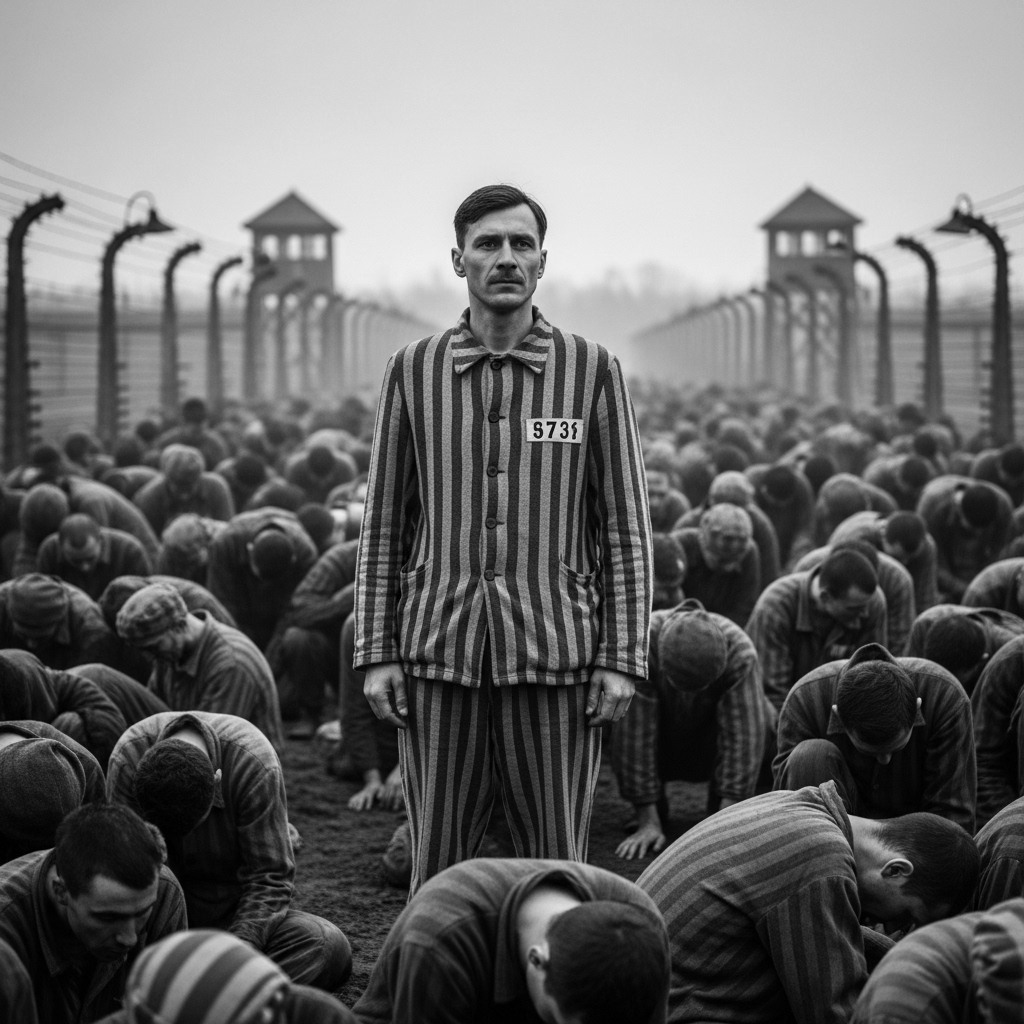
Witold Pilecki – A Hero Who Voluntarily Entered the Hell of Auschwitz

Witold Pilecki was a man whose courage, sacrifice, and loyalty to his country transcended all human understanding. In Poland’s history, scarred by the tragedy of World War II, few people deserve the title of national hero to the same degree as he. His story is not only a chronicle of courage but also a reminder of the power of human dignity, even in the face of absolute evil.
The Birth of the Fighting Spirit
Pilecki was born in 1901 in Olonets, at a time when Poland did not exist on the world map. From an early age, he was imbued with the spirit of patriotism and a deep belief in the rebirth of his homeland. When Poland regained independence in 1918, young Witold unhesitatingly took up arms, fighting in the Polish-Soviet War. It was there that a man was born who, for decades to come, would become a symbol of steadfastness—no matter how formidable the enemy might be.
When World War II broke out, Pilecki was already an experienced officer in the Polish Army. In September 1939, during the invasion of Nazi Germany, he joined the defense of the country. After the defeat of the September Campaign, he did not lay down his arms – he joined the clandestine organization Secret Polish Army , which soon became part of the Home Army . It was then that he made a decision that would forever change history – the decision to voluntarily go to the Auschwitz concentration camp.
Voluntary entry into hell
It was 1940 when Pilecki volunteered for one of the most dangerous missions of World War II. The goal was to gather information about what was truly happening at the newly established concentration camp in Auschwitz. At that time, the world had not yet fully grasped the horror of the word Auschwitz . It was known only that the Germans were sending thousands of Poles there—soldiers, intelligentsia, priests, and teachers. However, no one could have imagined the scale of the Holocaust and genocide.

Pilecki allowed himself to be arrested during a roundup in Warsaw. He was deported to Auschwitz under the false name Tomasz Serafiński. From the very first days of his stay, he realized he had found himself in the very center of hell. Cold, hunger, beatings, public executions—all this was part of a system designed to break the human spirit. But Witold Pilecki had a different goal. Against all odds, he began organizing a secret resistance network within the camp— the Union of Military Organizations (ZOW).
Resistance in the Shadow of Death
The ZOW’s mission was to gather information about German crimes and build underground structures among the prisoners. Pilecki relayed reports to Warsaw with remarkable precision and courage. These reports, transmitted through clandestine channels, became some of the first evidence that mass genocide was taking place at Auschwitz. Thanks to his information, the Allies first learned of the gas chambers and the systematic murder of Jews, Poles, and other European nations.
Pilecki didn’t just inform. He acted. He supported his fellow prisoners, kept their spirits up, organized food and medicine, and even planned an armed uprising in the camp. For many, he was a symbol of hope – a man who reminded them that even in a place designed for annihilation, humanity could still be preserved.
Escape from Auschwitz and the fight for the truth
After three years in the camp, on the night of April 26-27, 1943, Pilecki and two companions made a desperate escape. They managed to escape and reach Warsaw. He immediately reported what he had witnessed and seen to the Home Army command in a detailed report, now known as the Pilecki Report . This document is one of the most important testimonies of the Holocaust and the crimes of Nazi Germany.
Yet despite his warnings, the Allies long refused to believe the scale of the atrocities described. It took the world years to understand that Auschwitz was not just a labor camp but a gigantic death machine. Seeing the West’s indifference, Pilecki returned to the fight. In 1944, he took part in the Warsaw Uprising , fighting to the very end. After the capitulation, he was taken prisoner by the Germans, from which he was not released until after the war.

Fight against the new occupier
When it seemed that Poland would finally regain its freedom, Pilecki faced a new threat – Soviet totalitarianism. After the war, he did not emigrate, even though he could have. He remained in the country to continue serving his country, this time fighting the communist regime that enslaved Poland for decades to come. He worked underground, gathering information about the crimes and abuses of the new government.
In 1947, he was arrested by the Security Service. He was brutally interrogated—beaten, tortured, and humiliated. Despite his suffering, he betrayed no one. In 1948, a communist court sentenced him to death on trumped-up charges of espionage. He was executed on May 25, 1948, at Mokotów Prison in Warsaw. Witold Pilecki’s body was never found. For decades, his name was erased from history books.
A legacy of courage and memory
Only after the fall of communism could Poland speak openly about heroes like Pilecki. In the 1990s, the process of his rehabilitation began, and today he stands as a symbol of steadfastness, honor, and unconditional love for his homeland. In 2006, he was posthumously awarded the Order of the White Eagle – the highest state decoration of the Republic of Poland.
Witold Pilecki’s story is not just a fragment of Polish history —it is a universal tale of human dignity. In an era when the world is forgetting the values of World War II, his example reminds us that even an individual can stand up to the machine of terror. His life is proof that truth, though briefly silenced, will always return with greater force than lies.
Witold Pilecki in culture and collective memory
Today, Pilecki’s name is increasingly appearing in films, books, and documentaries about the Holocaust and World War II. He is becoming an inspiration for filmmakers who want to show that heroism is not about physical strength, but about strength of spirit. His life is taught in schools as an example of selfless sacrifice, and Auschwitz museums are increasingly displaying his reports as key testimonies of the era.
Pilecki remains one of the few people in history to voluntarily enter a concentration camp , escape, and tell the world the truth. His mission was not only an act of espionage but also a moral one—it demonstrated that a person can retain their humanity even in a place where death was a daily occurrence.

A steadfast symbol of Polish identity
Today, when we speak of Poland’s national heroes , Witold Pilecki’s name is placed alongside figures like Jan Karski, Captain Hubal, and General Anders. These are men who, in times of darkness, did not hesitate to stand for good, even if it meant death. Pilecki, looking at Auschwitz, knew that his actions could only result in one thing. And yet he went. Voluntarily.
Not for fame, not for distinctions, but for truth. And that is why his story endures.
Witold Pilecki isn’t just a character from textbooks—he’s a reminder that courage is a choice and freedom is a responsibility . Every generation of Poles, and beyond, can find a part of themselves in his life—the part that still believes that even in a world shrouded in darkness, one heart can ignite the light.
Note: Some content was generated using AI tools (ChatGPT) and edited by the author for creativity and suitability for historical illustration purposes.
Để lại một bình luận