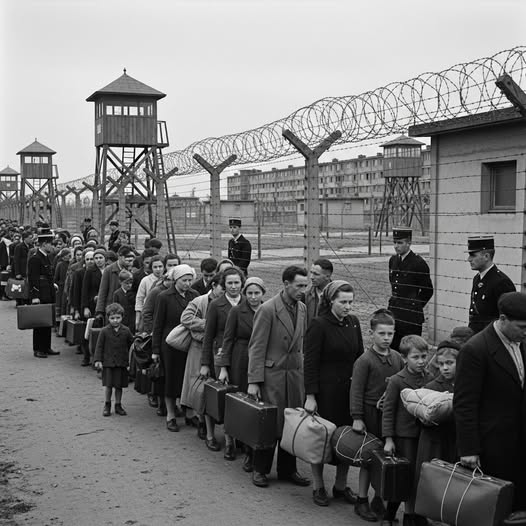
The Drancy transit camp (1941–1944)

There are places whose silence screams louder than any cry. Drancy is one of them.
Just a few kilometers from the center of Paris, between gray buildings and railway tracks, stood a modernist complex built before the war to house modest families. Its light-colored facades and geometric balconies were meant to embody the future of a rational and progressive France. Yet, from 1941 onward, this place designed to shelter life became a vestibule of death.
The beginning of a trap
After the Vel’ d’Hiv Roundup , buses arrived one after another without respite. Men, women, and children, huddled against their suitcases, were taken to what the administration euphemistically called an internment center . In reality, Drancy was nothing more than a transit camp, under German command but guarded by French gendarmes. Behind the barbed wire, the watchtowers, and the shouts of orders, the mirage of the capital vanished.
The locals sometimes saw, in the early morning, the smoke from the locomotives, faces pressed against the windows of the carriages, arms waving for a few seconds before the train disappeared to the east. They simply said: another train has left .
But for those who remained inside, each departure was an amputation. A part of their humanity departed with the sealed wagons bound for Auschwitz, Sobibor, or Bergen-Belsen.
Conditions in Drancy
The camp, surrounded by barbed wire and guard towers, was administered in a quasi-bureaucratic manner. The German officers took their meals in a separate building; the French gendarmes made the rounds, sometimes indifferent, sometimes complicit, sometimes consumed by shame. The internees slept on infested straw, shared meager rations of soup, and awaited the reading of the next list .
The lists were everything.
Every week, a crackling loudspeaker rattled off names: Cohen, Lévy, Szpilman, Weill… Some prayed not to hear them, others begged to have them read aloud so it would all be over. The waiting was a slower torture than hunger.
Between 1941 and 1944, more than 67,000 Jews passed through Drancy. Only a few thousand returned. The rest of their names are lost in yellowed registers, the archives of the Holocaust , and memorials where letters are engraved to prevent oblivion.
Henri Weill, the schoolmaster
Among these prisoners was Henri Weill , a young schoolteacher arrested for hiding Jewish children on a farm near Limoges. In Drancy, he discovered a world where even the light seemed filtered through fear. Yet, he continued to teach.
In the evening, when the police closed the gates, he would gather the children around him and tell them stories. He drew letters in the dust, tracing words of hope: freedom, courage, future. The children would repeat in a low voice, like a prayer: “The future.”
In a clandestine letter to his wife, he wrote:
“If our children remember us, let them remember that we did not renounce our humanity, even here.”
These words, taken from the camp hidden in the lining of a jacket, were found after the war. They bear witness to a resistance without weapons, that of the heart and mind.
The Shadow of Deportation
In August 1942, the convoys multiplied. Dozens of trains left each week, often at dawn, for Auschwitz-Birkenau. The children of the Vel d’Hiv were crammed into the wagons after a brief stop at Drancy. Henri Weill, too, was summoned.
A witness, Paul Léger, later recalled:
“He kissed a little boy before getting in. He told him, ‘Remember, you must keep learning.’ Then he left without looking back.”
None of those from convoy number 24 returned.


The memory of the walls
After the Liberation, the Drancy camp was discovered almost intact. The inhabitants of Paris were stunned to learn that such a hell had existed just a few metro stops from the heart of the capital. Some remembered the long lines of people marching towards the barbed wire, while others swore they had seen nothing.
Even today, the Cité de la Muette —as the complex was known—stands as a paradoxical monument: an ordinary building, yet burdened with an unbearable memory. The memorial museum on the site recounts the camp’s history through photographs, letters, and recovered objects: suitcases, notebooks, toys, a tiny child’s shoe. These relics tell a story that words struggle to express.
The police and guilt
The archives reveal that Drancy was guarded by French gendarmes, not SS. Some obeyed blindly, others looked away, a few discreetly helped to pass messages or food. But the majority simply obeyed.
This quiet, bureaucratic obedience is perhaps the most chilling part of the story. It shows how barbarity can be concealed beneath the cloak of routine.
A lesson in humanity
Today, in history classes, Drancy is discussed to teach about the Holocaust in France, collaboration, and collective responsibility. But beyond the figures and facts, this burning question remains: how can one retain one’s humanity in a world that denies it?
Henri Weill responded in his own way: through words, through passing on knowledge. Even in the depths of despair, he continued to teach. This fidelity to humanity makes him a symbol not only of intellectual resistance, but also of universal hope.
Every July 16th, the day commemorating the Vel d’Hiv roundup, his name resonates among so many others. His words are read, candles are lit. And somewhere, in the collective memory, the Drancy camp ceases to be a mere place: it becomes a warning.
The echo in the present
The internet is now teeming with searches for Drancy , a concentration camp in France , the Holocaust , Auschwitz , and the Vel’ d’Hiv roundup . Search engines track the words, but they cannot measure the emotional weight they carry. Every click, every article read, every video watched is a small victory against oblivion.
Visitors to the Drancy Memorial , whether students, historians, or simply curious, often leave in silence. For, standing before these grey walls, everyone understands that barbarity begins not with cries, but with indifference.
Epilogue: The Last Letter
In 1944, before his departure for Auschwitz, Henri managed to entrust a final letter to a comrade who remained at the camp. It read:
“Tell my students that words are weapons, that knowing how to read and think is already an act of resistance.”
These words were rediscovered much later, published in a collection about deportation.
And through them, the Drancy camp, this place of transit towards death, paradoxically becomes a place of transmission — a passage towards memory.
Because as long as we tell the story of Henri, that of the children of the Vel d’Hiv, and that of those anonymous people locked behind barbed wire, Drancy will live on not as a wound, but as a lesson : that of a people who, despite the shame and the pain, have not given up on remembering.
Note: Some content was generated using AI tools (ChatGPT) and edited by the author for creative reasons and suitability for historical illustration purposes.
Để lại một bình luận