The destruction of Rome’s Jewish community – October 1943: the day the Eternal City fell silent

There are days when the silence of history weighs more heavily than a thousand cries. On October 16, 1943, in the cool Roman morning, this silence descended upon the Italian capital—a silence pierced by the cries of children, orders shouted in German, and the metallic clatter of trucks waiting outside the narrow streets of the ghetto. It was the day Rome, the Eternal City, witnessed one of its darkest acts: the deportation of Rome’s Jews , orchestrated by the Nazi occupiers with the complicity of the local authorities. Few Romans dare speak of it today, so deep is the wound. But to understand the soul of a city, one must sometimes delve into its shadows.
After the armistice of September 8, 1943, Italy descended into chaos. German troops invaded the country, occupying Rome with chilling military precision. In the Roman ghetto , anxiety grew by the hour. For centuries, the Jewish community had lived there, rooted in the very heart of the papal city, its destiny intertwined with that of Rome. They had survived popes, emperors, wars, and epidemics. But nothing had prepared them for the Shoah , that implacable machine that left behind only ashes and emptiness.
In the days leading up to the roundup, the Nazis had demanded a ransom in gold: fifty kilograms, to be handed over within forty-eight hours, under threat of reprisals. The leaders of the Jewish community, in despair, had given everything. Distraught Roman families had even helped gather the precious metal to save their neighbors. But this promise was nothing but a trap. On October 16, at dawn, German soldiers, supported by the Italian police, surrounded the neighborhood. The orders were simple: arrest all the Jews, regardless of age or sex.
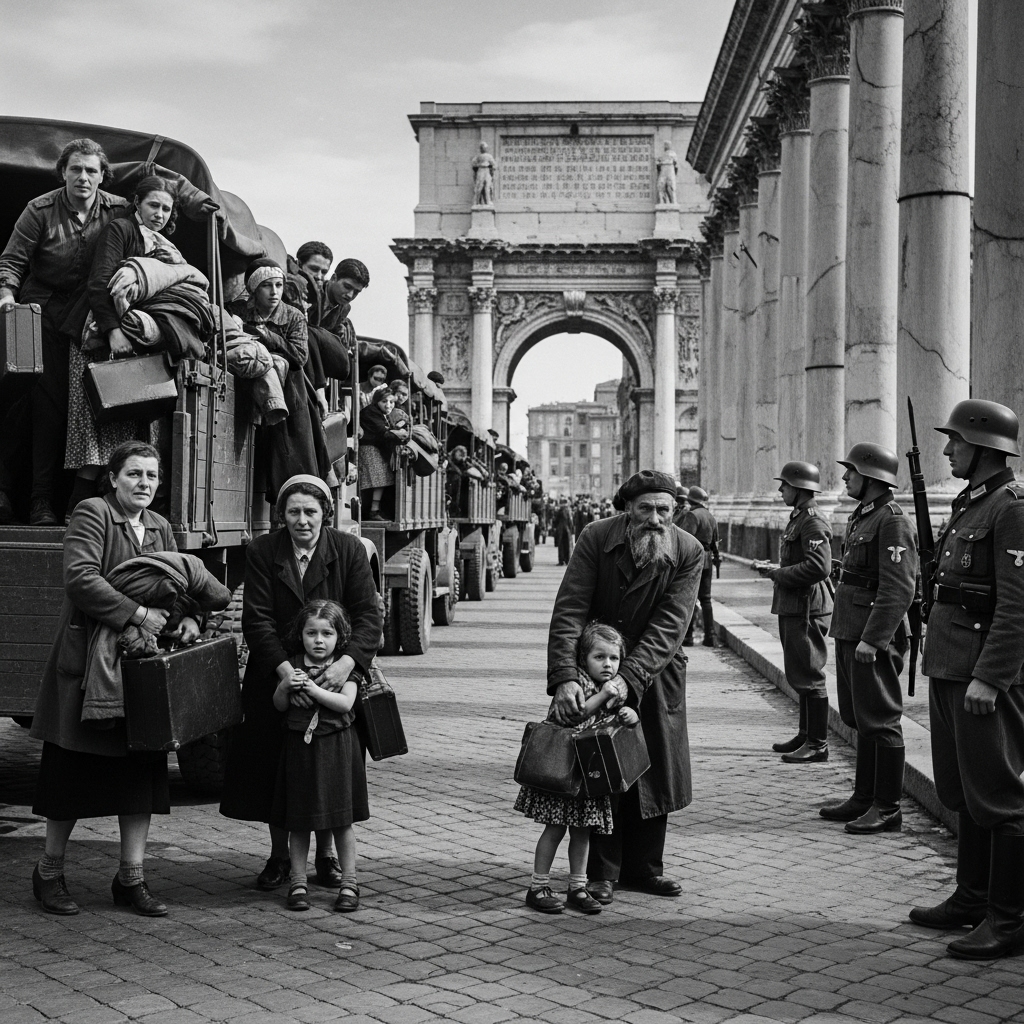
The trucks lined up along the cobbled streets leading to the Piazza delle Cinque Scole . That morning, the Roman ghetto was transformed into a scene of desolation. Mothers clutched their children tightly, old people tried to understand, men begged to be allowed to take home a souvenir, a photograph, a prayer book. Shouts mingled with the barking of dogs. From their windows, a few residents watched, petrified. Others, out of fear or cowardice, closed their shutters.
What history will remember is the speed and brutality of the operation: more than 1,000 Jews were arrested in a matter of hours . Men, women, and children—all were taken to the central square, then crammed into military trucks that transported them to the Tiburtina train station. There, sealed freight cars awaited, without water or air. Thus began a journey to Auschwitz , a name few yet knew, but which would become the ultimate synonym for industrial death.
For days, the families left behind in Rome waited for a sign. Rumors circulated: some hoped for a transfer to labor camps, others feared the worst. The truth came months later—cruel, implacable: of the 1,023 deportees from Rome, only 16 returned alive . Among them, only one woman. The rest had perished in the gas chambers of Auschwitz-Birkenau.

This tragedy was not an isolated incident, but part of a larger plan: the extermination of Italy’s Jewish population , orchestrated as part of the “Final Solution.” Yet, what makes the raid of October 16th so heartbreaking is its proximity to the spiritual heart of the Catholic world. While the bells of St. Peter’s rang for morning mass, children were being torn from their parents just a few hundred meters away. The contrast is unbearable: faith and barbarity, side by side, in the same city.
Some witnesses still recall the faces. A little girl in a floral dress, clinging to her grandfather’s hand. A mother trying to hide her tears by clutching an empty suitcase. An old man praying silently while a German soldier closes the truck door. These images, captured by time, remain a mirror of what humanity can lose when fear and hatred triumph over compassion.
But even in this utter darkness, there were glimmers of light. Ordinary Italians , aware of the horror, risked everything to save lives. Priests, nuns, and families opened their doors, hiding children in convents, cellars, and mountains. In the countryside, some forged identity papers, while others guided fugitives toward the still-free south. These discreet and silent acts of courage saved hundreds of Roman Jews. Even today, their names are listed among the Righteous Among the Nations , etched in the memory of the world.
Rome, after the Nazis left in 1944, never fully regained its innocence. The ghetto , though rebuilt, remains steeped in memory. The stones of the Piazza delle Cinque Scole, it is said, still echo the footsteps and tears of that October morning. Every year, the survivors—fewer and fewer in number—return to leave flowers, letters, and prayers. They do not seek vengeance. They ask only that they be remembered.
Memory: a fragile yet essential word. For the Holocaust is not merely a tragedy of the past. It is a warning. The deportation of the Jews of Rome reminds us how quickly civilization can falter, how the complicity of silence can kill. In Rome, this lesson was written not on paper, but on stone, in blood and tears.

Today, when you walk through the old ghetto, between the Tiber and the Theatre of Marcellus, you come across gilded plaques embedded in the ground—the stolpersteine . On each one, a name, a date, a place of deportation: Auschwitz . These modest yet poignant memorial stones are like heartbeats frozen in stone. Every passerby who lowers their gaze becomes a witness, if only for a moment.
On October 16, 1943, Rome lost not just a portion of its population; it lost a part of its soul. But from this grief arose a responsibility: to recount, tirelessly, so that the Holocaust in Italy is never relegated to a footnote in history textbooks. Behind every number, there was a face, a voice, a song, a child’s laughter. And this, above all, is what must be remembered.
Because writing is a way of resisting oblivion.
And as long as someone, somewhere, continues to tell the story of the Rome Raid , October 16, 1943 will not be completely buried in silence.
Note: Some content was generated using AI tools (ChatGPT) and edited by the author for creative reasons and suitability for historical illustration purposes.
Để lại một bình luận