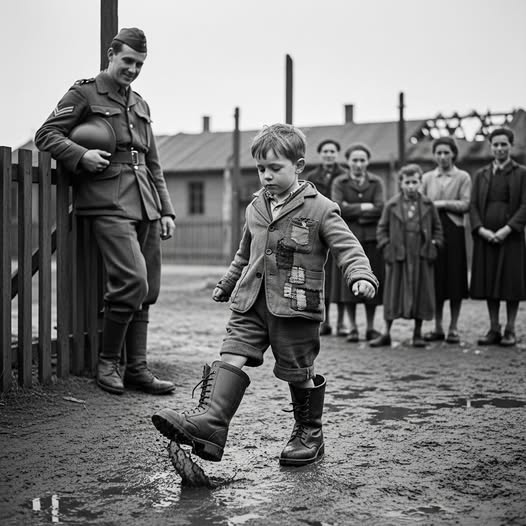
Boots Too Big – The Child of Bergen-Belsen

When the first supplies arrived at Bergen-Belsen after liberation, the camp’s silence was broken by forgotten sounds: the clatter of buckets, the rustle of new blankets, the heavy tread of Allied soldiers. Everything seemed unreal. After months—years—of faceless survival, life returned in the form of simple gestures: eating, washing, breathing without fear. But the true resurrection was reflected in the eyes of a child.
He was barely ten years old. His clothes hung on his frail body like shadows of a past too heavy to bear. They gave him a pair of British boots, enormous, almost grotesque on his small feet. The soldiers exchanged a glance, half amused, half moved. Yet the boy showed neither embarrassment nor sadness. He slipped his feet into the oversized boots, stuffed them with straw, and walked straight ahead. Each step made a comical sound, a clacking that seemed to laugh in the face of misfortune.
That sound, so commonplace elsewhere, became an anthem here. In this place where shouts had replaced music, the echo of those boots sounded like a new song. Some survivors turned around, intrigued; others smiled shyly. Even a British soldier, usually frozen in the gravity of the task, couldn’t help but chuckle softly. He placed his hand on the wooden fence, looked at the child, and said,
” You’ll end up wearing those boots.”
The boy raised his head, and in his eyes burned that rare flame that no war can extinguish.
” I fully intend to ,” he replied.
This reply, both naive and proud, flashed through the camp like a spark. The boots, too big for him, became a symbol. They were more than just clothing: they were a horizon. In each clumsy step lay the promise of a future, the affirmation that one can still move forward, even in someone else’s shoes, even on ground strewn with painful memories.
The camp was liberated by British forces on April 15, 1945. They discovered approximately 60,000 prisoners, mostly sick and starving, and thousands of unburied corpses. This horrific scene—bodies lined up like piles of wood, survivors on the verge of collapse—was one of the first real awakenings of world opinion to the horror of the Holocaust.
But let’s return to that precise moment: the child with the boots that were too big. Why does this image grip us? Because it encapsulates what the war sought to erase: childhood, dignity, hope. It’s not about “simply surviving,” but about “starting to walk again.” The boots didn’t fit him—they were too big—but he wore them. And in that gesture, a profound truth was revealed: resilience also lies in imperfection, in excess, in the incongruity .

Imagine: weeks of deprivation, of fear, of bodies shrinking to mere shadows of their former selves. The Bergen-Belsen camp had become an abyss of lost humanity. And to this abyss, a boy responded with a sound, the clatter of boots, which said: “I’m still here.” He wasn’t just a survivor; he was a forerunner of the future. He showed that walking wasn’t enough; you had to walk with what you had, with what didn’t yet fit, but which promised to fit.
A soldier had encouraged him: ” You’ll end up wearing them .” It wasn’t just a word of consolation. It was a prophecy. And the boy replied: ” I fully intend to. ” This simple and pure dialogue became the framework for a much larger story: one of reconstruction, of memory, of life reborn.
The liberation of Bergen-Belsen was not the end of the tragedy. On the contrary, it was the beginning of another battle: that of healing, reconstruction, and regaining dignity. British soldiers immediately had to organize the burials of the dead, contain typhus epidemics, restore the water supply, and distribute food suitable for emaciated bodies. Among the former prisoners , some did not even survive liberation: approximately 14,000 died in the weeks that followed, victims of their extreme fragility.
And yet, in this chaos, the child moved forward. Each clumsy step, each rustle of leather, each glance at the boots that were too long, announced that the world had changed, that life, despite everything, persisted. The symbolism is twofold: on one side, fragility—unsuitable shoes, a weakened body; on the other, strength—the intention to walk nonetheless, to advance on uncertain ground.
The boots were cumbersome, but they were his, a small yet significant piece of a future that had seemed impossible just days before. They were his first step towards reclaiming a future that had once seemed out of reach, a future that would be built with every step, however small.
This scene, recounted in several narratives of the liberation, remains a fragment among the millions of stories of the Holocaust. But it possesses a particular power because it is tangible, simple, human. A child, boots, a smile. In a moment when everything was falling apart, this boy showed that hope is not proclaimed loudly: it is put on and walked .
And in that moment, the boy’s resilience and determination spoke louder than words. He didn’t shout; he walked. He didn’t ask for boots that fit; he accepted what was offered, even imperfect, and adapted it to his voice. He didn’t say, “When I grow up I’ll walk.” He said, “I’m walking now, even if it’s not perfect.”
A few days later, the first tents were pitched, food distributed, and medical care organized. The camp began to breathe differently. But that boy, in his boots, kept walking. Every sound of leather echoed in the muddy courtyard like a challenge to oblivion. The past had tried to erase him, the war had tried to make him disappear, but he kept going.
Perhaps he never knew how much his action mattered. Perhaps, as he walked, he sought nothing more than: “to feel my feet move, to feel that I am still alive.” Yet, decades later, when the liberation of the camp is mentioned, some former soldiers remember him as a ray of sunshine in an ashen sky.
The boots were too big, yes. But it was in this disproportion that the beauty of the moment resided: the child, tiny in the face of the immensity of the pain, nevertheless moved forward. Each clumsy step on the mud of the camp was a victory over collapse, a silent declaration that the war would not have the last word.
And if those boots were too big, it was perhaps because they were made for the future—for the man he would one day become.
A man who would walk no longer on the earth of the camps, but on that of newfound freedom.
Note: Some content was generated using AI tools (ChatGPT) and edited by the author for creative reasons and suitability for historical illustration purposes.
Để lại một bình luận