Neuengamme 1945: the liberation of the concentration camp and the persistence of memory

In May 1945, Europe was nothing more than a field of ruins and ashes. The war was drawing to a close, but its scars remained, etched in the flesh of survivors and in the collective memory. Among the names inscribed in the pantheon of horrors, the Neuengamme concentration camp, located about twenty kilometers southeast of Hamburg, stood as a sinister symbol of Nazi oppression. Initially conceived in 1938 as a Kommando of the Sachsenhausen camp, it quickly became one of the largest concentration camps in the Reich, welcoming—or rather, engulfing—tenths of thousands of deportees from all over Europe.
In May 1945, when British troops finally reached the site, they discovered not the vastness teeming with prisoners that one might have imagined, but a nearly deserted space. Most of the inmates had been forced to participate in the terrible death marches, the funeral processions imposed by the Nazis to evacuate the camps before the Allied advance. Many did not survive these inhumane movements: exhausted, starving, shot as soon as they weakened, they disappeared into the anonymity of the ditches and German forests. Those who remained at Neuengamme were too weak to walk, or too determined to face death where they stood rather than sink into certain agony on the roads.
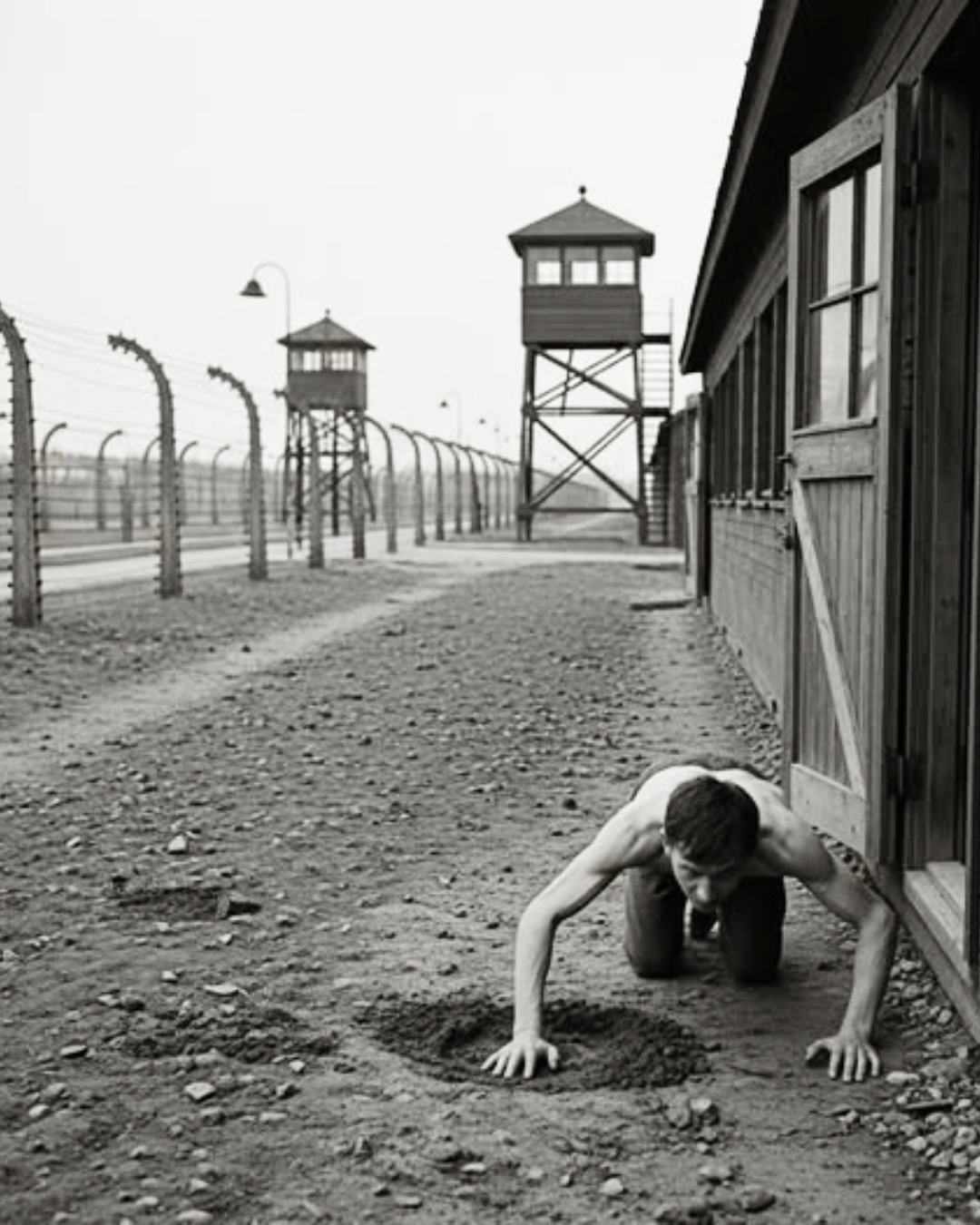
Among them, a man emerged from the shadows at the moment of liberation. His frail, almost spectral figure stood out against the harsh spring light. His eyes, accustomed to the darkness of the barracks and the grayness of days without horizons, narrowed before the glare of the sun. Hesitantly, he raised his hand to shield himself, as if afraid that even the brightness was an illusion. It had been years since he had seen this outside world except through barbed wire or under the threat of watchtowers.
He knelt, his knees hitting the still-damp earth. His hands, thin and trembling, sank into the soil. He wanted to feel the raw material, to touch reality, to root himself in what remained solid after so many years of brutality and uncertainty. His chapped lips let out a hoarse breath:
— I’m still here.
These three words contained more than a simple statement. They were the affirmation of survival, the silent cry of all those who had resisted annihilation. Neuengamme had failed to break it. His life, fragile but persistent, was a defeat inflicted on the project of extermination.
To understand the symbolic power of this gesture, we must return to what Neuengamme was. This camp was not intended for immediate extermination like Auschwitz-Birkenau, but it became a place of annihilation through labor. Tens of thousands of prisoners were exploited there to build bricks for the Reich’s great architectural projects, to drain swamps, and to participate in military projects. The labor, exhausting and deadly, was designed to crush bodies and minds.
Living conditions there were inhumane: starvation, disease, daily brutality, and arbitrary executions. The deportees, who came from all over Europe—French resistance fighters, German political prisoners, Jews, Poles, Soviets, and Roma—shared the same fate: to survive one more day in a world designed to erase them. As the war progressed and the German military industry collapsed, Neuengamme also became a transit point to death. Thousands of prisoners passed through here, only to be sent to other Kommandos or perish on the spot.

By the time the British reached Hamburg, the Nazis had already emptied the main camp. Columns of prisoners had been forced to march north, many loaded onto ships in the Bay of Lübeck. There, the drama reached its climax: several of these ships, carrying thousands of deportees, were sunk by Allied bombing raids that were unaware of the nature of their human cargo. It was a tragedy within a tragedy.
Neuengamme, at the time of its official liberation, was nothing more than a deserted place, haunted by a few hidden survivors and by the traces of the passage of tens of thousands of victims. The British soldiers were struck by the smell, by the heavy silence, by the empty barracks that seemed to cry out the absence of those who would never return.
Let us return to the man who, that day, knelt in the earth. His almost instinctive gesture was an anchor in real life after years of abstraction. In the camps, time dissolved. Days followed one another in a monotonous cycle of hunger, beatings, and forced labor. Sunlight and the passing of the seasons no longer meant anything. The camp universe was closed, artificial, governed by violence and fear.
So when he finally left the barracks to feel the wind on his face, to see the sky without barbed wire, to touch the earth free of all prohibitions, he knew he was still alive. It was more than an instinct for survival: it was an affirmation of regained dignity.
For the British, as for the Americans and Soviets elsewhere, the liberation of the concentration camps was an immeasurable shock. The soldiers who entered Neuengamme, Bergen-Belsen, Dachau, or Ravensbrück discovered a reality that even Allied propaganda had failed to fully imagine. Their testimonies, photographs, and films are now irrefutable proof of the Holocaust and Nazi crimes.
But for the survivors, liberation was an ambiguous moment. It meant the end of their imprisonment, of course, but it also opened the door to the unknown. Many had lost their entire families. Others no longer had a homeland to return to, their homes having been destroyed or confiscated. Their newfound freedom was a victory, but it carried the weight of absence, loneliness, and trauma.
At Neuengamme, the survivors knew they would now have a mission: to bear witness. Every gesture, every word, would be an attempt to convey what they had seen, so that the world would never forget.

Today, writing about Neuengamme 1945, the liberation of the Nazi camps, and the survivors of the Holocaust is not just about telling a page of history. It is also about nourishing the collective memory and making accessible to a wide audience what must never be forgotten. Keywords like Neuengamme , concentration camp , liberation 1945 , Holocaust survivors , death marches , are not just SEO levers to improve the visibility of an article: they are gateways to knowledge and memory.
Every Internet search is an opportunity to convey a historical truth, to enlighten a curious reader, to remind us that in the heart of the ruins of Nazi Germany, men and women rose up, bore witness, and continued to live.
The image of this man kneeling in the dust of Neuengamme, his hands buried in the earth, is one of the most powerful in the history of the liberation of the camps. It sums up everything: the accumulated suffering, the thirst for life, the rediscovered reality. He was not just a survivor: he was the bearer of thousands of silenced voices.
The liberation of Neuengamme in May 1945 was both a deliverance and a tragedy, for it revealed the extent of the human losses, the void left by those who never returned. Yet, in this void, in this silence, the persistence of a few survivors is enough to affirm that barbarism had not won.
“I’m still here,” this man had whispered. And through him, all of humanity affirmed its presence, its resilience, its will to never fade away.
Note: Some content was generated using AI tools (ChatGPT) and edited by the author for creativity and suitability for historical illustration purposes.
Để lại một bình luận