Ravensbrück 1945: The Liberation of the Women’s Camp – Memory, Suffering and Regained Dignity

In Ravensbrück, in April 1945, the barbed wire fences began to open, and with them, a whole chapter of 20th-century history was revealed. The camp, designed by the Nazi regime as the largest concentration camp exclusively reserved for women, saw its prisoners timidly step through the gates, their bodies sagging but their gazes fixed on a light they no longer dared to hope for. They were emerging from a world of darkness and pain, where hunger, beatings, forced labor, and daily humiliation had sought to shatter their very identities. Yet, on that April day, each of their steps, however hesitant, resonated like a victory over annihilation.
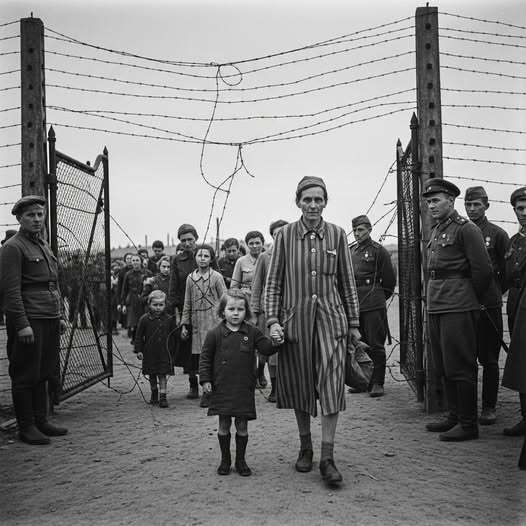
Among them, a woman advanced, firmly holding her daughter’s hand. Their silhouettes contrasted with the striped uniforms, the hollow cheeks, and the eyes wide with pain. The mother leaned toward the child and, in a barely audible whisper, whispered, “We march together now, not in rows.” These words, simple and moving, encapsulated the essence of liberation. For freedom, after years of forced marches, of disciplined lines under the eye of the SS, boiled down to this fundamental choice: to march side by side, in rediscovered humanity.
Ravensbrück was not just a camp: it was a laboratory of barbarism where Nazi ideology sought to silence, erase, and destroy women. Between 1939 and 1945, more than 130,000 women from all over Europe were deported there. Polish, French, German resistance fighters, Jews, Roma, and political opponents were all thrown into this hell in the name of a totalitarian ideology. Atrocious medical experiments were conducted there, particularly on young Polish prisoners nicknamed ” rabbits” because of the surgical experiments performed on their legs. Inhumane work rates were imposed in the workshops of the Siemens factory adjacent to the camp, where the deportees manufactured weapons and military equipment to fuel the war.
Hunger, illness, beatings, and systematic humiliation had transformed each day into a struggle for survival. And yet, in the middle of the night, gestures of solidarity were invented: a piece of bread shared, a song whispered in the dark, a look that restored courage. These gestures, seemingly tiny, were all acts of resistance against the will to annihilate. They allowed us to preserve a measure of dignity, to continue to believe in the possibility of an afterlife.

When the Soviet army liberated Ravensbrück in April 1945, the women left the camp like survivors of a shipwreck. Some, too weak, had to be carried. Others, barely able to stand, leaned on a companion. But all shared that surreal moment when the barbed wire fence no longer signified confinement but the passage to life. The mother walking with her daughter knew it: this gesture of moving forward together, hand in hand, sealed their survival and the promise of a shared future.
The liberation of Ravensbrück was not just a military event, but a rebirth of humanity. In this camp where attempts had been made to erase even the very idea of fraternity, every step outward became a proclamation of regained dignity. For these women, the right to walk freely, side by side, represented the absolute antithesis of the concentration camp logic: they were no longer numbers, silhouettes lined up, but human beings capable of choosing their direction.
Today, Ravensbrück remains an essential place of remembrance for the Holocaust and Nazi crimes. It commemorates not only the suffering endured, but also the strength of the survivors. Their testimonies remind us that liberation meant not only the end of barbed wire, but also the rediscovery of basic gestures: holding hands, walking together, breathing without fear. The memory of Ravensbrück is thus part of a broader history: that of the Second World War, deportation, and women’s resistance.
The photograph of these prisoners leaving the camp, surrounded by soldiers, illustrates the essence of this liberation better than a thousand words. Their tired looks, striped clothes, and weakened bodies contrast with the silent momentum that drives them forward. In the image of a mother holding her daughter, we see more than a memory: we see the transmission of life, the victory of family bonds over inhumanity.
The liberation of Ravensbrück, like that of other Nazi camps, is a universal lesson. It reminds us of the need to preserve memory, to fight against forgetting and against any resurgence of hatred. For in this “we walk together now” there is a legacy that transcends borders and generations: the certainty that freedom and human dignity cannot be confiscated forever.
Note: Some content was generated using AI tools (ChatGPT) and edited by the author for creativity and suitability for historical illustration purposes.
Để lại một bình luận