Ebensee 1945: The Liberation of the Death Tunnels – Survivors, Memory and Hope

At Ebensee, in May 1945, history suddenly took the form of a stifled cry, a breath regained, a tear that, for the first time in months, was no longer one of pain but of disbelief. When the American soldiers entered the camp, they discovered the unimaginable: endless underground galleries where thousands of men had been reduced to shadows, condemned to dig, carry, sweat, and die in the service of a war machine that considered them mere disposable tools. Ebensee, the last link in a concentration camp system designed to fuel the industrial madness of the Reich, revealed to the light of day the macabre spectacle of a humanity broken but still alive.
In the tunnels, the air was saturated with dust, sweat, and despair. The starving inmates could barely stand, reduced to skin stuck to their bones, their eyes hollowed out by hunger and fear. For months, they had lived without seeing the sky, buried in the night of the tunnels where the crashing of metal and the shouted orders of the guards echoed. Many no longer even knew what season reigned outside: time, deprived of light, had dissolved into an interminable present. The bodies numbered in the hundreds, and each day, death crept into the ranks like an inevitable companion. But that May day, something shifted.
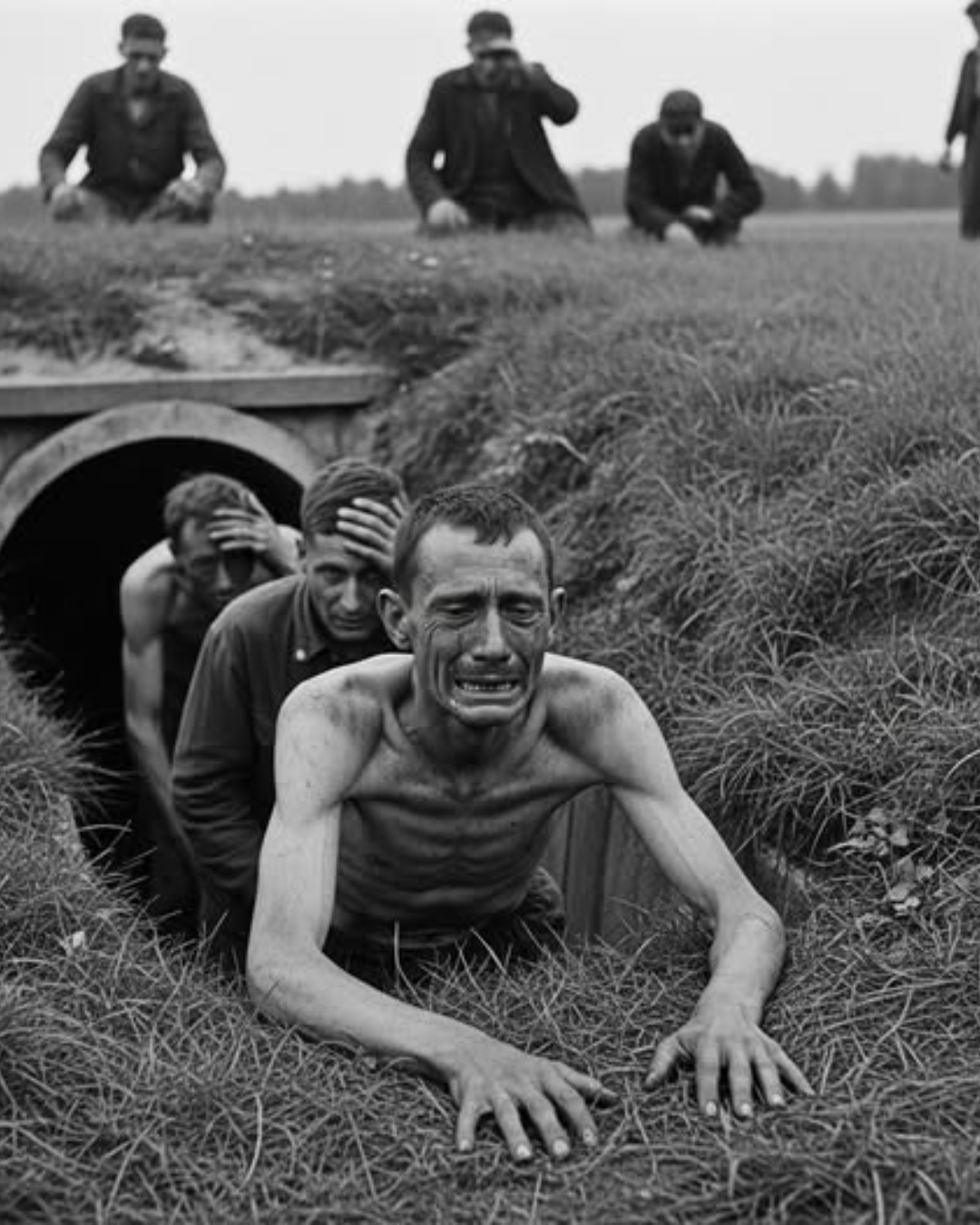
When they were called out, the survivors dragged themselves out of the tunnels. At first incredulous, they blinked, assaulted by a brightness they had forgotten. Then came the tears. The American soldiers watched, helpless and distraught, a scene that would forever be etched in their memory. A man, bare-chested, emaciated to the bone, fell to his knees. His trembling hands found the soft, damp grass. He stroked it as one caresses a long-lost child. Then his broken voice rose, repeating a single word, fragile and moving: “Green… green…” The color of life, the color of fields, of forgotten springs, became once again proof that the world existed beyond darkness and suffering.
This scene, recounted by several witnesses to the liberation of Ebensee, embodies with rare intensity what the moment of liberation from the Nazi camps represented. Through this simple word—”green”—emerges the entire symbolism of survival: grass became the antidote to death, proof that nature, indifferent to barbarism, continued to live, to grow, to breathe. For these prisoners, it was not only a matter of regaining freedom, but of rediscovering the very reality of the world. The return to light was not only physical, it was spiritual. Ebensee, a satellite camp of Mauthausen, was one of the most brutal and inhumane: prisoners were sent there to work on the construction of gigantic tunnels intended to house the Reich’s underground weapons factories. Many never left alive. The liberators’ accounts describe a landscape of horror: piled-up corpses, skeletal survivors, unable to believe that hell was coming to an end.

The image of these men emerging from the Ebensee tunnels illustrates the extreme contrast between the darkness of oppression and the light of liberation. The photographs taken at that moment, later shared around the world, helped to reveal the magnitude of Nazi crimes. Every lost gaze, every trembling gesture, every tear shed into the green grass became a silent but incredibly powerful testimony to what it meant to survive the unspeakable. In the silence that followed the guards’ surrender, the field echoed with sobs, gasps for breath, and murmurs of disbelief. For the Americans present, these moments were etched as an eternal lesson: human dignity, even when reduced to almost nothing, could still rise again.
Today, the name Ebensee is not as well known as Auschwitz, Dachau, or Bergen-Belsen, but its history remains essential to understanding the mechanics of Nazi terror. In this camp, thousands of men of all nationalities—Poles, Hungarians, French, Italians, Russians—were enslaved. Their bodies, consumed by hunger and forced labor, were sacrificed on the altar of an ideology that saw human beings only as tools of production. And yet, even in the darkness, a part of humanity remained. The prisoner’s cry, “Green,” reminds us that man, even on the brink of annihilation, retains the capacity to marvel at the simplest manifestation of life.

The evocation of this scene at Ebensee has spanned the decades as a universal metaphor. It asks us: what remains of man when everything is taken away from him? The answer is there, in that instinctive gesture of a hand brushing the grass, in that tear of gratitude before the color of the living earth. The memory of the camps is not only a memory of death, but also a memory of the return to life, of resilience, of the reappropriation of the world by those who had been deprived of everything. This is why it is crucial to remember, to write, to pass on. Every generation must hear these stories, not to wallow in the horror, but to understand what freedom means and to measure the price of human dignity.
By revisiting Ebensee, we see beyond the raw story; we grasp the profound meaning of liberation. The green of the grass, this detail so banal to us, then became a symbol of absolute hope. And this symbol is up to us to preserve, for it embodies both the fragility and the strength of humanity. In a world where violence, exclusion, and persecution persist, the voice of this prisoner still resonates, like a reminder of vigilance and compassion. The memory of Ebensee, far from being frozen in the past, continues to illuminate our present.
Note: Some content was generated using AI tools (ChatGPT) and edited by the author for creativity and suitability for historical illustration purposes.
Để lại một bình luận