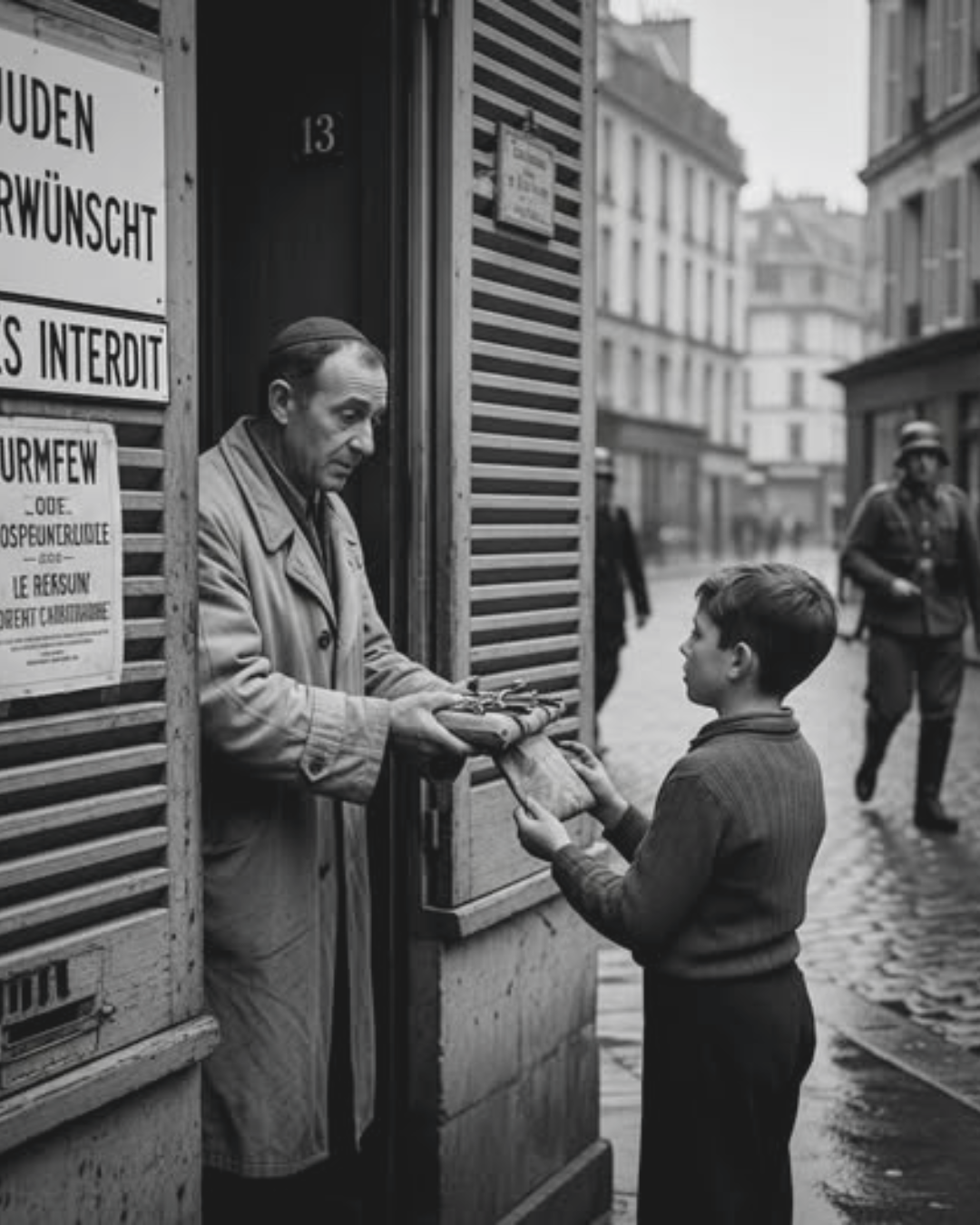
The Watchmaker’s Promise — Paris, 1942

In the Marais district, where the cobblestones of the Rue des Rosiers once echoed with the hurried footsteps of artisans and laughing children, a strange silence had settled. It wasn’t the soothing silence of the night, but the heavier silence that seeps in when fear becomes a daily habit. Behind the half-closed shutters of number 13, an old Jewish watchmaker still worked, stubbornly, as if the ticking of his watches could keep the world in balance.
His name was Isaac Lévy . For forty years, he had repaired other people’s time, stitching together seconds with the patience of a man who knew that every beat counted. His fingers, worn but precise, caressed the gears, adjusted the springs, and sometimes, in a barely audible whisper, he spoke to his watches as if they were old friends.
Outside, Paris in 1942 wore the uniform of fear. The Nazi occupation had plastered the facades with posters in stark lettering: “Jews Forbidden .” Foreign flags fluttered on the rooftops of the Republic. But inside the workshop, despite the dim light, time moved on, fragile and courageous.
Isaac had an apprentice— Julien , a thirteen-year-old boy, curious, quiet, with eyes too big for his age. Orphaned by a father killed at the front, he found a reassuring rhythm in the steady ticking of the workshop, a music against the chaos outside. Between them, words were few but sincere. Julien listened, learned, and sometimes asked questions about the war, about God, about time.
Isaac, for his part, always answered with images:
” You see, Julien, repairing a watch is a bit like repairing a soul. You have to understand where it stopped before you can get it going again.”
But for the past few weeks, the noose had been tightening. Rumors spoke of roundups, lists, and freight trains leaving the Gare de l’Est with no return. Isaac’s Jewish customers had disappeared one after another. His shop, “Horlogerie Lévy ,” had become a silent target. One morning, a sign was pasted on the door: “Juden unerwünscht – Jews not allowed .” The neighbors lowered their eyes.
That day, the old man understood that his workshop was going to die.
He spent the day tidying up, not out of resignation, but with the care of a father preparing an inheritance. Each watch had a story: that of a wedding, a soldier, a birth. He cleaned them one by one, as if saying goodbye.
Then, when evening fell, he called Julien.
The boy entered, worried. Shadows danced on the walls.
Isaac held a small package wrapped in a cloth.
“ Julien, these tools… you know them. The screwdrivers, the pliers, the needles. They are my hands now. Soon, they will come to close this door. Perhaps sooner than we think.”
The old man searched for his words, then added in a trembling voice,
“ Make time go on for us.”
Julien wanted to protest, but his master’s gaze silenced him. He took the package, clutching it like a treasure.
That night, the soldiers came . The sound of boots on the cobblestones, the curt orders, the door being forced open. Isaac Lévy was taken away in a dark truck, under the gaze of the neighbors who dared neither move nor speak. In the street, a watch fell from his pocket, shattering on the stone. The second hand stopped at 11:17 p.m.
Julien was left alone. The next day, the shop was sealed. On the door, one could now read: “Property of the French State.”
But the promise still echoed.
The months passed. The war grew harsher. The rationing, the hunger, the denunciations. Yet, every evening, in his mother’s cellar, Julien unpacked the linen and caressed the tools of his departed master. He tried to understand their secrets, learned to make the dead watches tick again. Little by little, he managed to bring some of them back to life—clumsily, but with passion.
He sold them discreetly to those who needed money or a memento. And each time a watch was sold again, he murmured:
” For Isaac Lévy.”
The bitter winter of 1943 arrived. One evening, as he was returning from an errand, Julien crossed paths with a man in a gray coat who asked him,
” You repair watches, kid?”
Julien hesitated. The man added in a low voice,
” I’m with the Resistance. We need clocks that slow down time.”
Thus began another battle. In the shadows, the apprentice from Rue des Rosiers became the clandestine repairman for the “Liberté” network . He modified alarm clocks to delay explosions, falsified watches to confuse patrols, and hid miniature messages behind silver covers.
Every tick became a silent weapon against the Occupation.
One evening, in an attic in Montreuil, he adjusted the last Isaac watch he owned. Inside, he slipped a tiny piece of paper: “Time does not stop. Even when men fall.”
It was his way of keeping the promise.
August 1944. Paris is liberated. Bells ring, tricolor flags reappear in windows. Julien, now fifteen years old, walks through the crowd, clutching the small bundle of yellowed linen. He walks up the Rue des Rosiers. Number 13 is still there, devastated, the shop window shattered, the clock hands frozen for two years.
He goes inside. Dust dances in the morning light. On the counter, an untouched watch. The one that had stopped at 11:17 p.m. He picks it up, winds it. The ticking returns, faint but clear.
In that sound, Julien hears his master’s voice:
” Time, Julien. It’s the only thing a man cannot steal.”
The years pass. Paris is reborn. The Marais once again becomes a place of life, memory, and light. In the spring of 1955, a new sign appears above number 13:
“Lévy & Sons Watchmaking . ”
Inside, Julien, now a man, welcomes his first customers. He rarely recounts the story of the old watchmaker, but on a shelf behind the counter, Isaac’s stopped watch still rests. It no longer tells the time; it serves as a reminder of the value of silence and the power of a promise.
Some evenings, when Paris falls asleep and the last passersby disperse, Julien closes the shop and stays alone, listening to the whisper of time. He thinks of Isaac, of the war, of that promise made in the night of 1942.
And sometimes, he thinks he feels a light hand on his shoulder, like a thank you from elsewhere.

Epilogue: Memory in Motion
Every year in July, flowers mysteriously appear in front of the shop. An elderly woman, a survivor of the Vel’ d’Hiv roundups, claims she knew Isaac Lévy — “He was a man who repaired watches the way one repairs the world.”
She tells passersby that, during the Holocaust , some chose to save lives, others to preserve memory.
Isaac chose both.
Time continued, as he had requested. And each tick-tock, in this small workshop on Rue des Rosiers, is a reminder that even in the darkest hours, humanity still finds the courage to fight.
Note: Some content was generated using AI tools (ChatGPT) and edited by the author for creative reasons and suitability for historical illustration purposes.
Để lại một bình luận