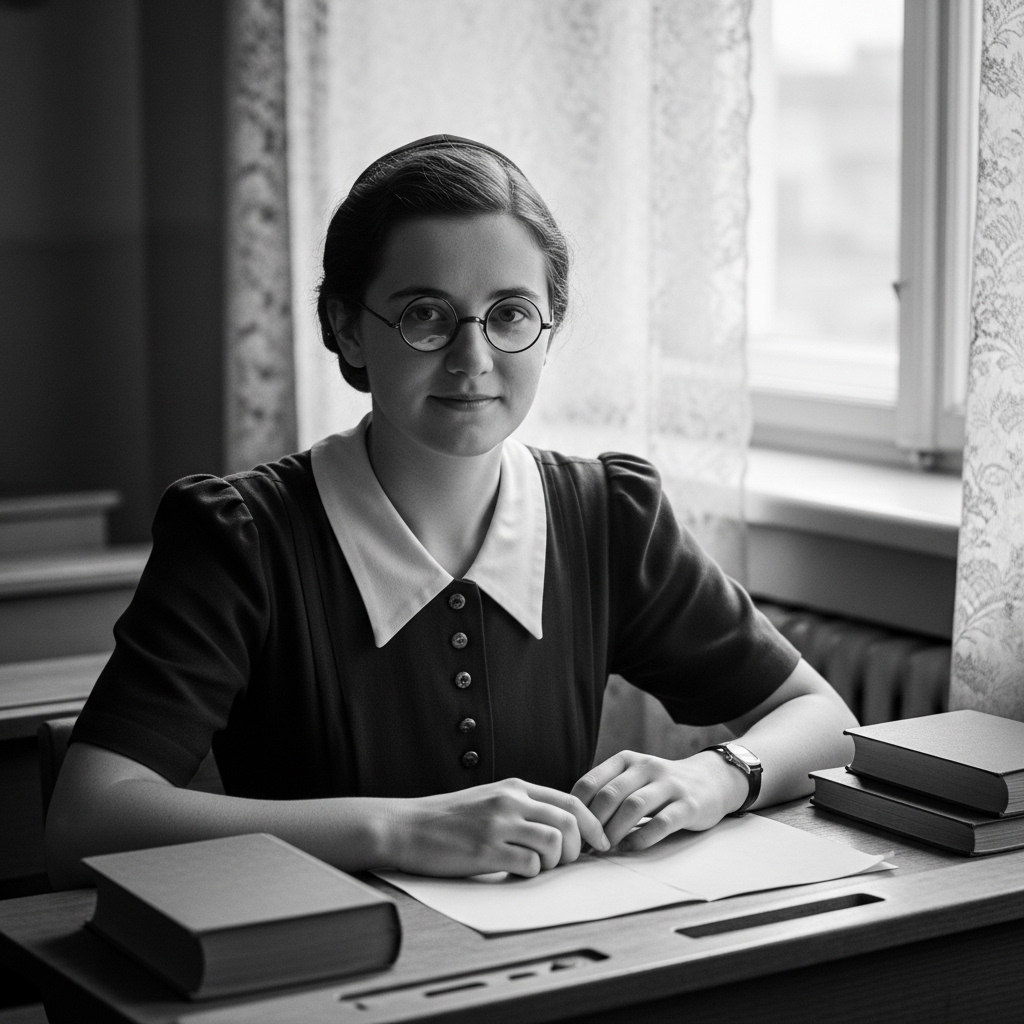
Anna Löwyová — The Echo of a Broken Chalk

Anna Löwyová was born on May 17, 1912, in Prague , in the heart of a Europe still cradled by the promises of modernity. In the cobblestone streets of the Vinohrady district , the windows of the small family bookstore glittered like a haven for dreamers. Her father, Rudolf , sold books with the tenderness of a man convinced that words could save the world. Her mother, Marta , greeted each customer with a quiet smile, the dust of old pages clinging to her fingertips. It was there, amidst the scent of ink and the warmth of the paper, that Anna learned to love knowledge—not as wealth, but as a promise of freedom.
From a very young age, she discovered that curiosity is an act of resistance. While other children played in the alleyways, Anna spent hours reading the great Czech and French authors: Neruda, Zola, Hugo . She understood that education was not a luxury, but a responsibility. When the time came to choose her path, she became a teacher—a vocation more than a profession.
To her students, she often repeated:
“If you forget how to ask questions, you forget how to be free.”
This phrase, etched in the memories of those who knew it, would soon become an act of faith in a world that was sinking into darkness.
The 1930s were years of darkness and tension. The air of Prague was thick with rumors, fear, and uncertainty. When the Nazi occupation became a reality, familiar faces were tinged with worry. The windows of Jewish bookstores were smashed, newspapers censored, and schools emptied. Anna, as a Jewish teacher , had to witness the brutal closure of her school. The blackboard, once alive with laughter and debate, now remained silent. Yet, in this oppressive silence, she chose courage.
For Anna Löwyová refused to give up.
She decided to teach in secret , in dark apartments, damp cellars, and attics where geography and history lessons were whispered like forbidden prayers. The children arrived in small groups, their eyes wide with fear, their pockets full of crumpled papers. Anna, dressed in her dark robe and with her ever-present, discreet smile, spoke to them of the world, of the beauty of knowledge, of the importance of never forgetting where one comes from.
“One day,” she said, “you will tell our story.”
This true story would become one of the most poignant chapters in Czech Jewish memory.
On July 9, 1943 , Anna was arrested and deported to the Terezín (Theresienstadt) ghetto. There, reality surpassed all imagination: the walls oozed fear, hunger mingled with despair, but despite everything, a spark remained. Anna resumed her role as a teacher, as if the act of teaching could suspend the barbarity. With other women, she organized clandestine classes for the children of the ghetto. The notebooks were made from torn pieces of newspaper , the pencils replaced by charcoal.
The children called her Madame Anna with silent devotion. She spoke to them of a world beyond the barbed wire, of a Europe reborn, of a humanity that even executioners could not stifle. In the evenings, amidst the murmur of the dormitories, she recited poems by Heine or Baudelaire , transforming the darkness into a fragile shelter of words.
Her quiet but unwavering feminine courage made her a figure of educational resistance . In a place designed to erase all traces of humanity, she chose to transmit—again and again—dignity, memory, and faith in life. Some survivors would later say that it was thanks to these secret lessons that they survived the madness.
In October 1944 , Anna was registered on Transport Ek , one of those convoys to Auschwitz from which no one returned. The records stop there; her name disappears into the gray smoke of the archives. She was only thirty-two years old . But death does not erase the voices that taught hope. In the silence of the camps, her memory remained a fragile light.

What history doesn’t always tell us is that some of his students survived. One of them, years later, would write in a notebook found in Jerusalem:
“She taught us grammar, but in truth, she taught us how to remain human.”
This sentence sums up Anna Löwyová better than anything else: a simple, yet immense woman, whose memory still inhabits the corridors of History.
Today, in a Prague school , a plaque bears his name. The children read on it:
“To Anna Löwyová, teacher, who made knowledge an act of freedom.”
Beneath these words, sometimes a dried flower, a notebook page, a pencil is placed. Simple gestures, like an echo of what she believed: that freedom begins with a child’s hand writing.
But the most fascinating aspect of this story is what we still don’t know. What became of his notebooks? Were they hidden, burned, or passed on? Some rumors suggest that a fragment of his notes was found in the ruins of Terezín, a sheet bearing these words:
“Education is stronger than fear.”
No one knows if these lines are authentic, but they ring true. They resonate like a universal truth , a secular prayer for all those who still believe in the power of knowledge.
And therein lies the power of this true story of the Holocaust : in the enduring traces, in the unwavering will to understand, to tell, to never forget.
Every year, visitors travel to Terezín, walking slowly between the cold walls of the ghetto. They place a stone, in silence. Some know its name, others do not. But all feel this invisible weight: that of a broken piece of chalk that continues to write, beyond time.
Anna Löwyová left no children, but she left something far more precious: a lineage of thought . Her students, their children, and those who read her story today perpetuate her work. For to tell Anna’s story is to continue teaching. It is to extend her voice. It is to make each reading an act of remembrance and resistance.
And as generations pass, his message remains strikingly relevant:
“To ask questions is to refuse servitude.”
So, if one day you walk into a classroom, if you hear the scraping of chalk on the blackboard, remember Anna Löwyová. Her story is not just that of a Jewish woman during the Second World War; it is the story of all the courageous women who transformed fear into knowledge, silence into teaching, and darkness into light.
Because as long as there is a student somewhere in the world, timidly raising their hand to ask a question, Anna Löwyová will never truly be dead.
Note: Some content was generated using AI tools (ChatGPT) and edited by the author for creative reasons and suitability for historical illustration purposes.
Để lại một bình luận