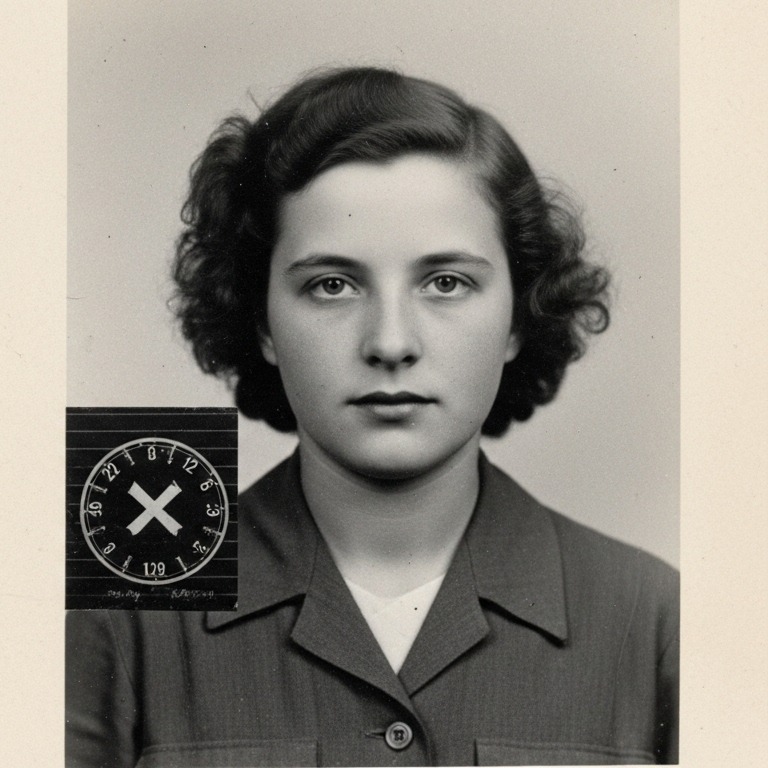
Lisette Moru — The young girl who refused to be silent

She was only seventeen – but she refused to remain silent.
Born on July 27, 1925, in a quiet corner of southern France, Marie-Louise Pierette “Lisette” Moru was the eldest daughter of a simple and loving Catholic family. Her life should have been that of an ordinary teenager: studies, walks, laughter with friends, dreams of the future.
But the Second World War left no one the luxury of an ordinary life.
When the German troops crossed the demarcation line, Lisette was only fifteen years old. In her village, the atmosphere changed—there was no more laughter in the streets, no more songs on the radio, only the metallic clatter of German boots on the cobblestones. Neighbors whispered, glances were averted, and fear seeped like a cold mist into every house.
Yet, amidst this stifling atmosphere, Lisette felt something else: a quiet anger. She saw tricolor flags replaced by swastikas. She saw Jewish families disappear overnight. And she understood, at an age when one should still only be thinking about first loves, that silence was a form of complicity.
That’s when she made her choice: she would not be a spectator .
Lisette joined a small local resistance network led by a schoolteacher and a mechanic. Nothing spectacular: no weapons, no explosions, just paper, ink, and courage. She helped distribute anti-Nazi leaflets , copy clandestine bulletins from the Combat movement , and report the passage of German convoys.
At night, she and her friend Louis, a nineteen-year-old boy, silently roamed the streets, pasting posters on the walls:
“France will live.”
“Liberty, Equality, Fraternity – even under the ashes.”
During the day, she worked at the local textile factory. There, too, she observed. Some employees murmured words of allegiance to Vichy; others averted their eyes when German trucks passed by. Lisette, for her part, discreetly jotted down names in a small notebook: those who betrayed, those who collaborated, those who sold out entire families for a few banknotes.
One evening, Louis said to her, laughing softly:
“You know, if someone finds this notebook, we’re lost.”
She simply replied:
“Then nobody must find it.”
In the spring of 1942, a British RAF plane crashed near the village. Lisette, along with two friends, went to lay flowers at the crash site. A tiny, almost innocuous gesture—but one that, under the Occupation, could be considered a crime. Two women from the neighborhood denounced her.
A few weeks later, German soldiers arrived at the family home. They searched everything: the books, the sheets, even her mother’s sewing box. In a cupboard, they found leaflets , a notebook , and coded letters from Louis. Lisette said nothing. Not a word. She made no attempt to defend herself.
The soldiers arrested her in front of her parents.
Her father tried to intervene. She turned to him, her gaze clear, and said,
“Papa, don’t say anything. I’ll be back soon.”
But she never returned.

Lisette was first transferred to Montluc prison in Lyon — a grim place where hundreds of French resistance fighters passed before deportation.
Then, in August 1942, barely seventeen years old, she was sent in a convoy to Auschwitz-Birkenau .
In the identification photo taken upon her arrival, she stands tall, dignified, almost serene. Her lips are slightly parted as if she were about to speak, her eyes fixed fearlessly on the camera. It wasn’t arrogance. It was courage . A silent way of saying: You can lock me up, but you won’t have me.
The camp records mention her name, age, and nationality. Not much else. It is assumed that she died on April 24, 1943. No trace of a burial site. No grave. Just a number lost in the dust of history.
But the survivors of the convoy, those who were able to testify, remember her: a young girl who shared her bread with another sick prisoner, a girl who recited prayers in a whisper at night, a girl who, until the end, refused to lower her eyes.
When the war ended, Lisette’s parents received an official letter.
A few cold, bureaucratic lines:
“Your daughter, deported on August 19, 1942, is presumed deceased.”
Nothing else. No exact date, no place of death, no body.
Silence became their mourning.
For decades, no one spoke of her. Not the neighbors, not the town hall, not even the family, too heartbroken.
Then, in 2008, a local historian rediscovered his file, his letters, and above all, his photograph. It is this portrait, the one you see here, that brought everything back to life: that youthful, calm gaze, yet burning with an inner light.
A plaque was installed in front of his birthplace:
“Lisette Moru, a resistance fighter, lived here and died for France at Auschwitz.”
And, in a nearby school, a room was named after her. Today, children learn her story, sometimes in silence, sometimes with tears in their eyes, but always with respect. Because at seventeen, she understood something that many adults have never grasped: courage knows no age.
Lisette didn’t just defy a totalitarian regime.
She embodied the purest form of resistance: that of the heart.
She didn’t carry a weapon, didn’t blow up bridges, didn’t kill enemies. She simply said no .
No to injustice.
No to fear.
No to the idea that youth should remain silent in the face of power.

And that no, whispered by a teenage girl in 1942, still resonates today like a cry in the silence of decades.
When you look at her portrait, you don’t just see a victim. You see a promise: that freedom always has a face, and that it often resembles that of a girl who smiles despite everything.
Even today, through museums, archives, and testimonies, the story of Lisette Moru continues to be reborn.
She inspires writers, teachers, and students. Her name circulates in educational projects on the French Resistance and the memory of Auschwitz .
Every year in April, flowers are laid at the foot of the memorial plaque.
Sometimes they are left by veterans of the Resistance.
Sometimes by children.
And among them, a twelve-year-old girl whispered one day:
“She was like me, just a little braver.”
Perhaps that, ultimately, is the true meaning of memory: understanding that history is not over, that it continues through those who remember it.
Lisette Moru was neither a network leader, nor a spy, nor an armed fighter. She was a seventeen-year-old girl who chose to act when so many others remained silent.
She embodied the noblest ideal of the French Resistance: faith in human dignity, even on the brink of the abyss.
Today, as the world remembers the camps, the names engraved on the walls of Auschwitz and the shadows of the Second World War, her face remains a reminder: freedom is sometimes defended by a simple gesture, a word, a look straight at the enemy.
Lisette did not live long.
But she lived with dignity.
And that is the true triumph.
Note: Some content was generated using AI tools (ChatGPT) and edited by the author for creative reasons and suitability for historical illustration purposes.
Để lại một bình luận