Majdanek’s shoes: when objects become memory

When the Red Army breached the gates of Majdanek in July 1944, it expected to find an empty camp, hastily abandoned by its guards. What it found defied comprehension. Entire barracks, neatly aligned, were still full. But what chilled the soldiers most was neither the still-smoldering crematoria, nor the barbed wire, nor even the mass graves discovered just a few meters away. It was a silent sea of shoes: tens of thousands of pairs piled high, mute witnesses to a tragedy no one could have invented.
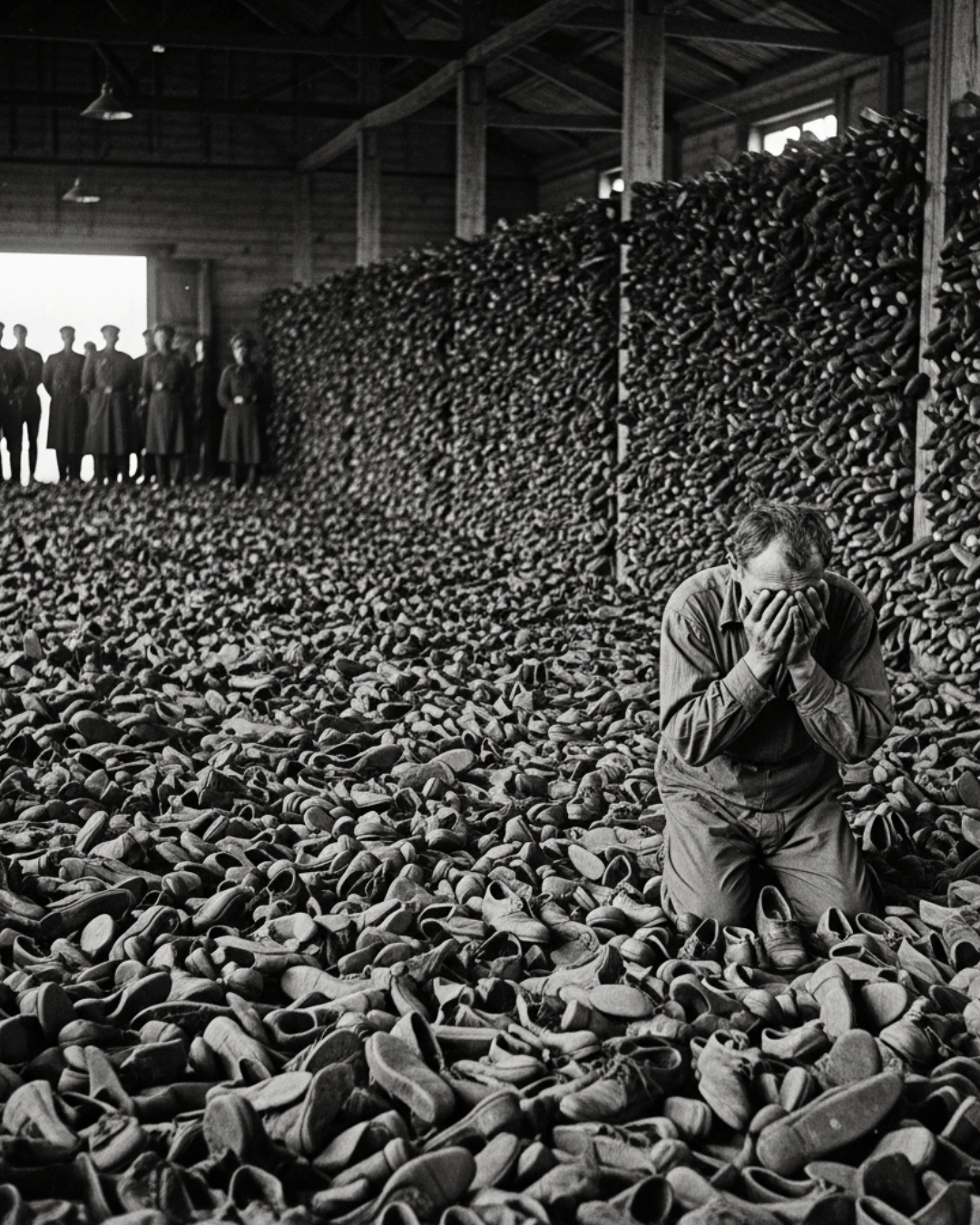
The image of a survivor, kneeling, collapsed amidst this field of leather and rubber, will remain etched in the collective memory. This man was speechless. He had simply covered his face with his hands, unable to confront this immensity of absence. Each sole seemed to echo with the footsteps that would never again resound. Each discarded shoelace told the story of a life abruptly cut short.
It is said that he murmured, in a barely audible voice: “Each pair is a voice. Each pair is a world.” In that sentence, he had summed up the entire horror. The shoes, ordinary objects par excellence, had become the most terrible archives of an unspeakable crime.
Majdanek was not only an extermination camp, but also a center of systematic looting. The Nazis did not simply destroy bodies; they stripped both the living and the dead of everything that could be recycled in the war economy. Hair was used to make felt. Eyeglasses were sorted and sent to Germany. And shoes, carefully collected, awaited reshipment.
When the Soviet soldiers entered the main warehouse, the stench of leather mingled with mold and death made them recoil. Yet what struck them even more than the smell was the sheer quantity. A mountain of shoes—children’s, women’s, men’s: worn, torn, or sometimes brand new, never worn. They weren’t just lying on the floor, but piled against the walls up to the ceiling, as if the walls themselves were breathing.
That’s when reality became impossible to deny. Each pair corresponded to a person. And each person had disappeared.
For the survivor who collapsed amidst this sea of leather, these were not anonymous objects. They were embodied memories. Perhaps he recognized a shape, a size, a detail. Perhaps he was searching, as so many others have done, for the trace of a brother, a wife, a missing child.
Historians have often emphasized the quantifiable aspect: the thousands of shoes allow us to estimate the number of victims. But the hidden truth lies elsewhere: behind each pair is a unique life, an intimate story, an entire world silenced. These objects are not statistics, but absent portraits.
Witnesses recount that some survivors, after the liberation, rushed into these warehouses, hoping to find a familiar shoe. But after a few moments, they stopped, overwhelmed by the truth: the immensity of the loss rendered the search futile. What they found was not an object, but a collective tomb.
Faced with the horror, the Soviet soldiers understood they had to document it. Photographers were immediately dispatched. The Majdanek photographs, showing those mountains of shoes, were among the first irrefutable evidence of the Holocaust revealed to the world. Some in the West cried propaganda, so unimaginable did the reality seem. But the photos, films, and testimonies were there: too precise to be fabricated.
There is, in this act of documentation, a form of heroic action. The soldiers were neither writers nor poets. But by photographing these shoes, they transformed a collection of objects into a universal language. No one needed a translation to understand: a child, a woman, a man had walked in these shoes. And now, they were no more.
Some survivors, who later became iconic figures in Holocaust remembrance, recounted how they perceived these images. For them, the Majdanek photograph was proof that they had not dreamt it, that their ordeal was not an illusion born of hunger or pain. These images were their certificate of existence, the indelible mark that the untold story would not disappear into oblivion.
Today, the shoes from Majdanek and those from Auschwitz, displayed behind glass, continue to speak. They speak to the generations who did not experience the war, to young people who are astonished to see so many similar yet all different objects. They speak to researchers who sometimes discover, in a sole or a heel, a forgotten inscription, a hand-carved initial. They speak to families who never had a grave to visit and who find, in these display cases, an echo of their lost loved ones.

But they also raise a dizzying question: how to transmit the unspeakable? How to teach that behind each pair of shoes lies a destroyed world? That is the role of memory: to transform silence into language, absence into presence, leather into testimony.
The hidden truth of these warehouses is not only that of the crime, but also that of the enduring power of memory. For despite their desire to obliterate even the memory of the victims, the Nazis failed to erase these traces. These shoes, intended for the war effort, became their own condemnation.
The survivor kneeling amidst the shoes reminds us that pain has no end. Even after liberation, even after victory, there are places where time stands still. Majdanek is one of those places. There, objects speak louder than words.
Every visitor who enters these rooms today becomes a custodian of a legacy. There are no tombs for all the victims, but there are these shoes. They look at us, silent, and compel us to hear what silenced voices can no longer express.
Perhaps this, ultimately, is the greatest of historical secrets: that in a simple everyday object lies the power of an entire memory. An abandoned child’s shoe, a worn sole, a solitary shoe is enough to remind us that history is not only made up of great battles and official dates. It is made up of interrupted steps.
And through these stopped steps, all of humanity is asking us never to look away.
Note: Some content was generated using AI tools (ChatGPT) and edited by the author for creativity and suitability for historical illustration purposes.
Để lại một bình luận