Sweden’s Refuge: When Malmö Became a Port of Reclaimed Dignity
In April 1945, as Europe crumbled under the din of the final battles and the Allied armies approached the Nazi concentration camps, a glimmer of humanity shone from the north. Its name: Sweden. Its symbol: Malmö, a port city that, almost overnight, became the scene of a quiet upheaval, where human compassion regained its ascendancy after years of darkness. It was called the Refuge of Sweden , but for those who set trembling feet on Malmö’s icy shores, it was something more: a resurrection.
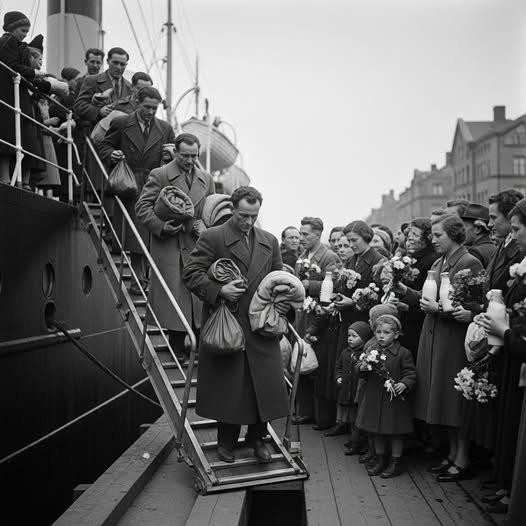
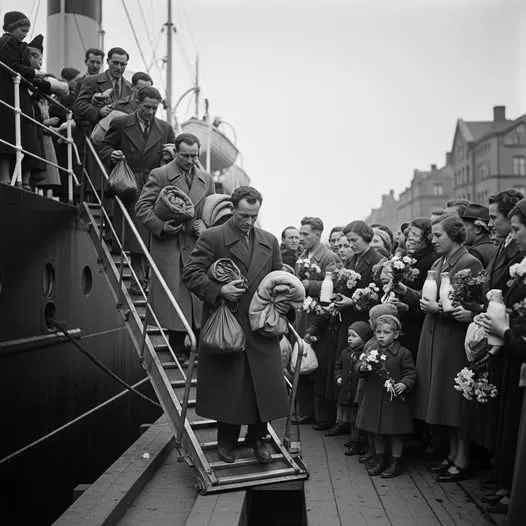
Witnesses still recall the moment the ships docked, filled with emaciated, emaciated survivors, barely bearing a trace of the humanity lost in the camps. They slowly descended the gangplank, clutching thin bags or a simple blanket, while a crowd of civilians, volunteers, and members of the Swedish Red Cross waited for them in silence. Suddenly, gestures appeared: a bottle of milk handed to a child, a warm coat draped over emaciated shoulders, a bouquet of flowers placed in hands that knew only chains. The scene repeated itself day after day, like a liturgy of kindness.
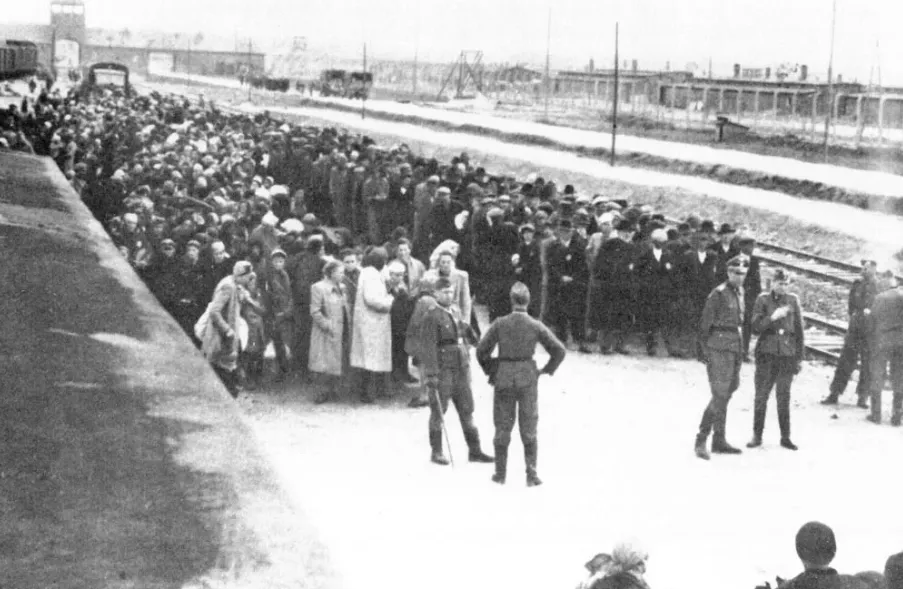
But before these images of compassion, darkness reigned. Before the refuge in Sweden, the hell of the camps reigned.
For months, the Swedish Red Cross, led by Count Folke Bernadotte, had been preparing an unprecedented humanitarian operation: Operation White Buses . These vehicles, repainted white with a large red cross on the roof and sides, crisscrossed war-torn Germany, searching for those whom Nazism had condemned to disappearance: political prisoners, resistance fighters, women and children, but also, increasingly, Jewish survivors of the extermination camps.
Every journey was a mad gamble: bombed roads, routed troops, absolute chaos. Yet these buses tirelessly carried exhausted people back to Denmark, and then to Sweden. The final journey led to Malmö, the port where survivors finally set foot on land that was not their enemy. For many, it was the first time in years they encountered a gaze that held no hatred, contempt, or indifference.
Imagine the scene. It’s April 28, 1945. The sky is low, and Malmö Harbor is buzzing with anticipation. On the quayside, Swedish families from the city and surrounding villages hold bouquets of flowers and still-warm bottles of milk. Some have brought bread, others clothes. No one speaks too loudly. Everyone knows they are about to greet the ghosts returning from oblivion.
As the gangplank is lowered, a stunned silence descends upon the crowd. The first survivors appear. Their gaunt figures resemble shadows rather than people. Their sunken eyes scan the platform with disbelieving suspicion. Then an outstretched hand, a hesitant smile, and suddenly a tear rolls down a cheek. The survivors understand that they have finally reached a place where no one wants to harm them.
One woman later recalled, “When they handed me a glass of hot milk, my hands were shaking so much that I spilled it. The Swedish woman who gave it to me simply smiled at me, kissed my forehead, and said, ‘ You’re alive, you’re with us now .’”
In moments like these, the entire nation gave its dignity a new name.
One of the most striking aspects of the Refuge in Sweden was the simplicity of the gestures. A cloak draped over icy shoulders. A flower placed in a bony hand. A loaf of bread to be shared. At first glance, these seem like platitudes. But for those who had emerged from the world of concentration camps, where every smile could cost one’s life and every gesture of mutual aid was punishable by death, these acts took on a sacred dimension.
One must imagine the significance of a bouquet of flowers offered to a deportee. In the camp, flowers were a forbidden luxury, crushed under the boots of the guards. In Malmö, a little girl gave a white rose to a man who had forgotten even the color of spring. It was rebirth.
Sweden not only welcomed its visitors warmly, but the state, the Red Cross, and its citizens quickly established an impressive system for the time: specialized hospitals, nursing homes, and sanatoriums for those suffering from tuberculosis and malnutrition-related illnesses.
In Lund, Helsingborg, and even Malmö, buildings were converted into medical shelters. There, doctors and nurses cared for the survivors with infinite patience. Many could no longer speak, some refused to eat for fear of being attacked, and others jumped at the sound of even a single footstep. Swedish caregivers had to re-teach these men and women what it meant to live without fear.
For these children, Sweden became a foster home. Some were orphans who had lost everything in the chaos of the ghettos and camps. Swedish families took them in, sometimes permanently. For these children, Sweden became not only a refuge but also a new home.
Although Sweden offered milk, bread, and flowers, it couldn’t immediately erase the internal wounds. Survivors bore invisible scars that often never healed. Nights in Malmö were still interrupted by screams. Survivors dreamed of returning to Auschwitz, Ravensbrück, or Dachau.
Many later admitted they found it difficult to accept Swedish kindness. How could anyone believe these foreigners truly wanted to help them, after all these years when the slightest help turned into betrayal?
And yet, despite everything, confidence gradually returned. Malmö Harbor thus became the site of an extraordinary phenomenon: a return to life amidst the incomprehensible.
Today, when we think about World War II, our collective memory is dominated by images of the camps: barbed wire, barracks, lost gazes. But it’s also important to remember gestures of light. The refuge in Sweden embodies this light. It reminds us that even in the devastated Europe of 1945, there were places where compassion was more important than indifference.
Sweden, which remained neutral during the war, was sometimes criticized for its political prudence. But by 1945, its role was clear: it had become a refuge, a sanctuary where thousands of souls could breathe again.
The survivors themselves spoke of it as a miracle. One of them, liberated from Ravensbrück, wrote in his diary: “When I got off the ship in Malmö, a child gave me a flower. I didn’t know what to do. I couldn’t remember what it meant to receive something without having to steal it. That was the first moment I understood that I was human again.”
To this day, Malmö and several Swedish cities commemorate the arrival of survivors in 1945. Museums recreate the White Bus and the role of the Swedish Red Cross, displaying moving photographs: faces scarred by suffering, yet illuminated by a fragile flame as they touched Swedish soil.
These photos are not just archives. They are a warning, but also a legacy. They show that in the face of barbarism, one can respond with kindness. That in the face of destruction, one can rebuild. That in the face of dehumanization, one can restore dignity.
Refuge in Sweden is not just a story about the survivors of 1945. This story still resonates today as other refugees, other survivors of war and genocide, knock on doors across Europe and beyond. Every time people open their arms, offer a coat, a glass of milk, or a flower, they perpetuate Malmö’s legacy.
This isn’t just the story of Sweden, nor the story of the Holocaust. It’s the story of humanity choosing compassion.
In May 1945, the war was drawing to a close. But for the survivors, the fight for life was just beginning. Malmö became that first port, that first land where they could set foot without fear. And even if the scars remained, even if the shadows never entirely disappeared, the Swedes’ actions offered something valuable: proof that humanity could be reborn.
This is what Refuge in Sweden symbolizes . Not just a humanitarian episode, but a turning point. Where strangers, with milk, bread, and flowers, made survivors feel alive again. Where the world understood that after the horror, one must not only judge, but also care, welcome, and love.
And even today, as ships dock and refugees leave their suitcases in an unknown port, the echo of the events in Malmö in 1945 resonates like a promise: as long as there is an outstretched hand, hope will not die.
Note: Some content was generated using AI tools (ChatGPT) and edited by the author for creativity and suitability for historical illustration purposes.
Để lại một bình luận