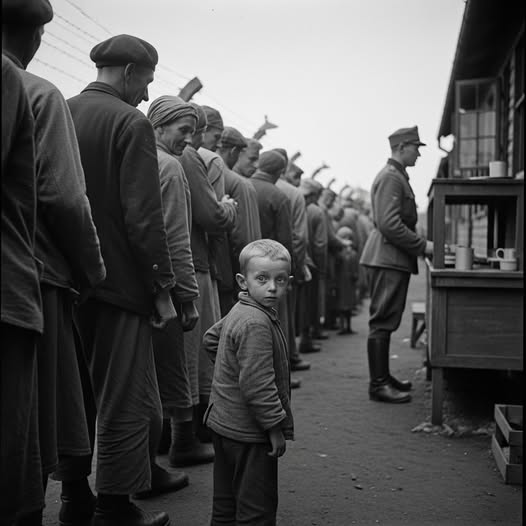
The Boy Who Stood in Line Twice – Majdanek, Poland, 1944

On Polish soil, in the shadow of Majdanek’s barbed wire, stories unfolded that are impossible to forget or recount without a tremor in one’s voice. In a camp where every day was a fight for survival, where humanity was put to the ultimate test, a figure emerged whose image remains etched in the memories of survivors – an emaciated boy who dared to stand in line for soup twice.
It was 1944. Winter and hunger cut the air more fiercely than frost. Prisoners lined up in long, motionless lines, waiting for their cups of watery soup. What resembled only dirty water in the pots was, for them, the elixir of life, the thin line between another day and inevitable death. He stood in that line too – a child who had lost his family, his name, and his age, remaining only a shadow in the eyes of adults.
SS guards, clad in gray uniforms, stood by with cold indifference. To them, each prisoner was a number, a faceless part of the war machine. Yet the boy, barely ten years old, found the courage to reposition himself after emptying his bowl, hiding among the emaciated figures of the adults. He was so small and thin that he often escaped the attention of his captors. His eyes, large and hungry, betrayed more than just a desire for food—the desperation for life smoldered within them.
The other prisoners noticed him. Even though they were starving, they found room within themselves for a gesture of pity. “Let him pass,” they murmured, stepping aside so the boy could take his place in line. “Now he’s just a shadow,” they added, gazing at his slight frame. In a world where every morsel of bread could decide fate, this little bit of kindness was worth more than gold.
Majdanek, one of the largest concentration camps in occupied Poland, was a place of suffering for thousands of people—Jews, Poles, Roma, and Soviet prisoners of war. Most of them never left. In the barracks, suffused with the stench of disease and death, the boy searched for a shred of hope. He knew that every spoonful of soup could prolong his life by a day, maybe two. But it wasn’t the liquid itself that mattered most. It was the people who allowed him to “cheat the system,” who gave him the feeling that something like humanity still existed.
When the Red Army liberated Majdanek in the summer of 1944, the boy weighed a mere 22 kilograms. His body was a shadow, but his heart beat stubbornly, as if in defiance of everything history had in store for him. Later, many years after the war, when asked how he managed to survive, he replied calmly:
“It wasn’t the soup that saved me. It was the kindness of those who allowed me to get back in line.”
These words sound like an epitaph for all who, in the hell of the camp, found the strength to share a shred of humanity. The story of the boy from Majdanek is not simply a tale of survival. It is a testament to the fact that even in the darkest places, in times when evil seemed omnipresent, a spark of good existed.
The memory of this child reminds us that the history of the Holocaust is not just the number of victims, the statistics of camps and crimes. It is individual faces, glances, gestures. It is the boy who got in line twice, and the people who allowed him to pass.
Today, when we visit the site of the former Majdanek camp, we see rows of barracks, piles of shoes, and rusty barbed wire. But the true testimony lies in such stories. They build a bridge between the past and the present, reminding us that every life mattered.
This story also carries a message about the power of solidarity. In a world where we easily turn a blind eye to the suffering of others, the example of Majdanek raises the question: what does it mean to be human in times of trial? Can we offer a hand when we ourselves are barely able to stand?
The boy who survived Majdanek grew over time. Although his body forever bore the scars of the camp, his words gave strength to subsequent generations. He remembered the people who, despite fear, despite death, were able to give him a moment of life. They were his heroes, the anonymous guardians of humanity.

This story should resonate even louder today. At a time when the world is once again experiencing war, displacement, and hatred, the memory of the boy from Majdanek reminds us that even the smallest gesture of solidarity can save lives. This is a message we must not lose.
At the end of this story, an image remains: a small boy, crouched among the tall silhouettes of prisoners, gazing wide-eyed at a guard. He holds an empty bowl in his hands and a quiet hope in his heart. Little did he know then that he would become a symbol – not a hero with a gun in his hand, but a witness to the fact that in the hell of the camp, even the smallest act of kindness could illuminate the darkness.
And as we repeat his words today: “It wasn’t the soup that saved me. It was the kindness of those who allowed me to stand in line again,” we feel that the true power of history lies not in great battles but in small gestures that sustain life.
Để lại một bình luận