The Story of the Dog at the Fence – Mauthausen, May 1945
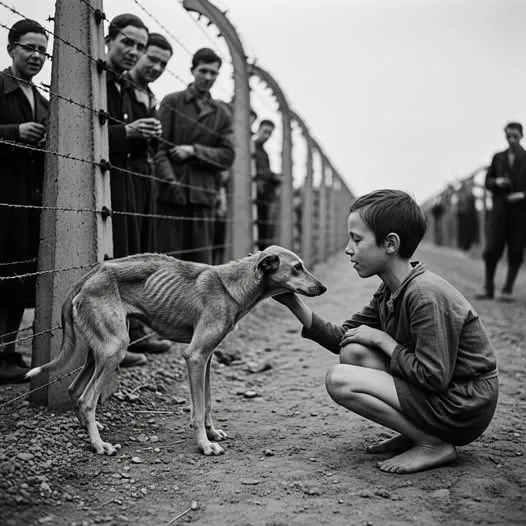
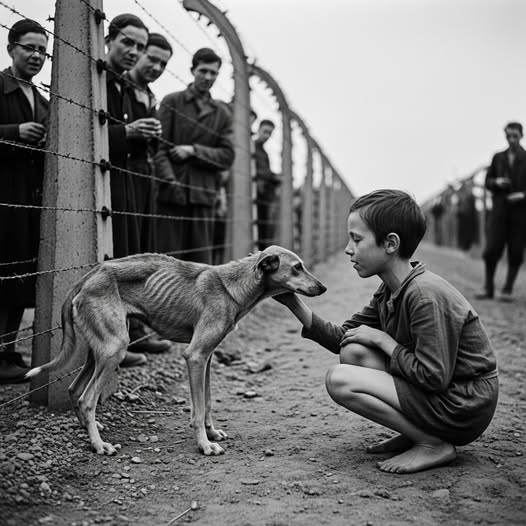
There are images that mark history not for the violence they depict, but for the fragile tenderness they reveal. Among the thousands of photographs captured after World War II, there is one that still moves us today: a young boy, a survivor of the Mauthausen concentration camp, crouching barefoot in the dust, extending his thin hand toward a stray dog as hungry as he was. Behind the barbed wire, the survivors silently observe this improbable encounter, as if frozen in a moment of rediscovered humanity. This scene, immortalized in May 1945, is not just an anecdote; it is a metaphor, a silent cry amid the ruins of barbarism.
Mauthausen concentration camp, located near Linz, Austria, was one of the harshest camps in the entire Nazi concentration camp system. Built in 1938, it initially housed political prisoners and then became a site of extermination through forced labor, where tens of thousands of deportees from across occupied Europe were sent: Spanish Republicans, Poles, Jews, French resistance fighters, and Soviet prisoners of war. The nearby granite quarries, with their endless staircases that prisoners had to climb under overwhelming weight, became a symbol of this methodical mechanism of extermination.
Hunger, beatings, disease, and summary executions turned Mauthausen into an open-air hell. It is estimated that over 90,000 people perished there. Despite the ubiquitous death, despite the organized terror, moments of solidarity survived: a piece of bread, a gesture of comfort, a word whispered in the darkness of the barracks. It was in this desolate place in May 1945 that the unexpected image of a child and a dog appeared.
When American soldiers arrived at Mauthausen on May 5, 1945, they found starving figures, empty stares, and bodies barely alive. Accustomed to war, the soldiers were nonetheless shocked by the scale of the barbarity revealed. The gates opened, the barbed wire ceased to be a deadly boundary, and in the chaos, a new breath was born: freedom.
The survivors, too weak to cry out for joy, greeted their liberators with silent tears. Some lay on the ground, as if basking in the light, others searched for a familiar face, a hand to shake. Then a dog, an ordinary stray dog, from nowhere, slipped through the fence and slipped among the survivors.
He wore neither collar nor medal. His skin clung to his bones, a testament to the privations experienced by the men around him. But his eyes still held a spark of life, a confidence. His tail twitched delicately, like a fragile flag raised amidst the ruins.
Amid the silent crowd, the boy stepped forward. His legs trembled under the weight of hunger and years of suffering. His bare feet ground against the hard earth of the camp. Yet he crouched slowly, as if not wanting to frighten the animal. He reached out a hesitant hand, his thin fingers trembling with a forgotten emotion.
The dog approached, sniffed, and then gently rested his head on the child’s hand. The boy smiled back. And—a miracle even greater than liberation—he laughed. A pure, almost brittle laugh escaped his lips. This sound, which neither hunger nor fear could completely suppress, rang out like a challenge to death, a promise that life would reclaim its rights.
For those who witnessed this scene, it was a moment of grace. In this camp marked by screams and tears, the moment of silence was filled with a simple contact: a hand on rough fur, a damp muzzle on bony skin. The dog demanded nothing, judged nothing. It offered what the executioners sought to annihilate: selfless, selfless, unpredictable affection.
What this dog represented went far beyond its animal presence. For the survivors, it embodied a return to normalcy, a reminder that simple gestures and pure connections still exist. In that moment, the dog became a silent messenger of hope.
In the accounts of Mauthausen survivors, many speak of the moment of liberation as a rebirth. Some remember the first pieces of chocolate offered to them by American soldiers, others the feeling of the sun on their skin. But this boy and this dog presented a different image: an innocent, wordless encounter capable of expressing what was most important.
The Holocaust dehumanized millions of people, reducing them to tattooed numbers, to starving bodies. The sight of a child petting a dog signified that humanity was not dead, that it could be reborn even from the ashes of the crematoria.
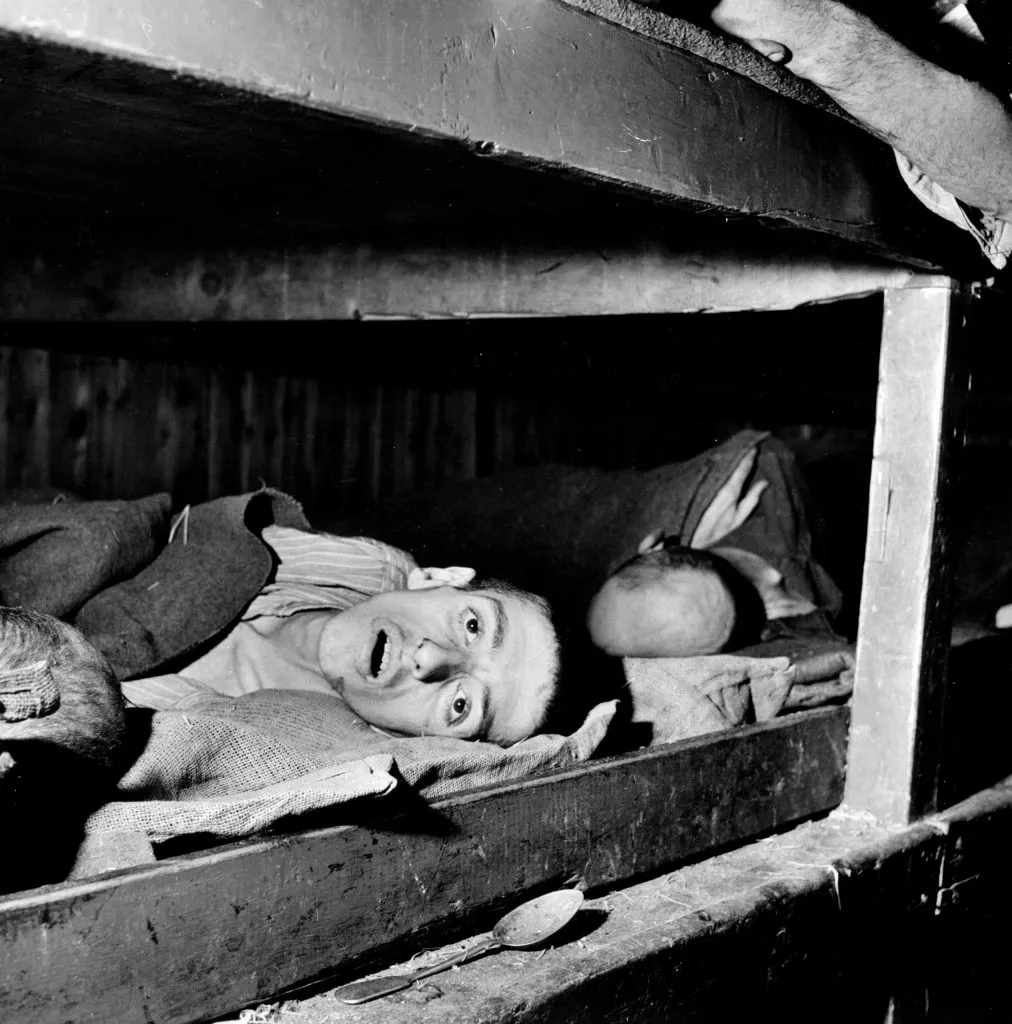
Today, the Mauthausen site has become a place of remembrance. Visitors from around the world come there to understand, remember, and share their experiences. The cold stones of the quarries, the still-standing barracks, and the barbed-wire walls are reminders of the cruelty of a system that sought to crush humanity to the core. But alongside these material traces, individual stories also shape memory.
The story of the boy and the dog is one such story. It doesn’t appear in the statistics, nor does it change the horrific death toll. But it sheds light on the human face of this tragedy. It suggests that even in the hell of the Holocaust, glimmers of life and tenderness could remain.
Many of those who experienced Mauthausen forever bore the physical and psychological scars of their imprisonment. Some witnesses recounted that such moments—a smile, a gesture, a touch—kept them confident in the future. The laughter of a child petting a stray dog stuck in their minds as a sign that another life was possible after the barbarism.
The photograph of this scene has circulated in books, exhibitions, and articles. It remains controversial, and some question its authenticity, but that’s beside the point: whether it’s a raw document or a symbolic reconstruction, it became a turning point in the collective imagination. It embodies what the liberation of the camps signified: not only an end to immediate suffering, but also a rebirth of hope, an opening to a future where love and innocence could blossom anew.
The story of “Dog at the Fence” at Mauthausen in May 1945 is more than a moving image. It is a lesson in memory. In this context of death and devastation, an ordinary animal and a starving child managed, for a moment, to redefine the concept of humanity. Their encounter reminds us that human dignity can survive anything, even the merciless machinery of a concentration camp.
In the face of constant violence, wars and discrimination in the contemporary world, this memory calls us to protect innocence, cultivate tenderness and never forget that the history of the Holocaust is not only numbers and facts, but also small gestures that gave new life.
The dog and the child from Mauthausen are therefore not just silhouettes of the past: they still look at us from behind the barbed wire of time to remind us that even after horror, hope can be reborn from a caress and laughter.
Để lại một bình luận